
Playbooks· 16 min read
We Reviewed the 5 Best Website Visitor Identification Software Tools in 2026
We compared 5 website visitor identification software tools on person vs company matching, signals covered, and what each tool does after it finds a match.
 Amos Bar-JosephCo-Founder & CEO ·
Quick Summary
Website visitor identification software names the companies and people behind anonymous visits to your site. The best tools also tell your team what to do next. We ranked Swan first for teams that want each qualified visit researched, checked against the CRM and turned into a drafted next step. RB2B is the budget pick for person-level names in Slack. Warmly suits teams that want AI chat and ads to engage visitors while they browse.
| Tool | Best for | Match level | What happens after a match | Pricing |
|---|---|---|---|---|
| Swan | Teams that want to act on each visit | Person and company | Enriches the visit, checks the CRM, then alerts the owner or drafts outreach | Usage-based credits, free trial |
| RB2B | Small US teams on a tight budget | Person (US only) and company (global) | Sends names to Slack or Teams and pushes them to other tools | Free plan, paid from $79/mo |
| Warmly | AI chat and ads for live visitors | Person and company | AI chat, alerts, routing, email, LinkedIn and ad follow-up | From $10,000/yr |
Why Most Website Visits Never Become Pipeline
A buyer from a target account opens your pricing page twice and leaves. Most visitor identification tools will tell you who that was. Very few will tell you what to do about it.
So the work lands on a rep. They research the company, look for an existing CRM record, work out who owns it and draft a note. If they’re busy that afternoon, the alert sits unread while the buyer keeps comparing vendors.
That’s why we didn’t stop at match rates. We compared five tools on three questions. Does it name the person or only the company? Which signals does it cover beyond the visit? And what happens once it knows who arrived?
Why Listen to Us?
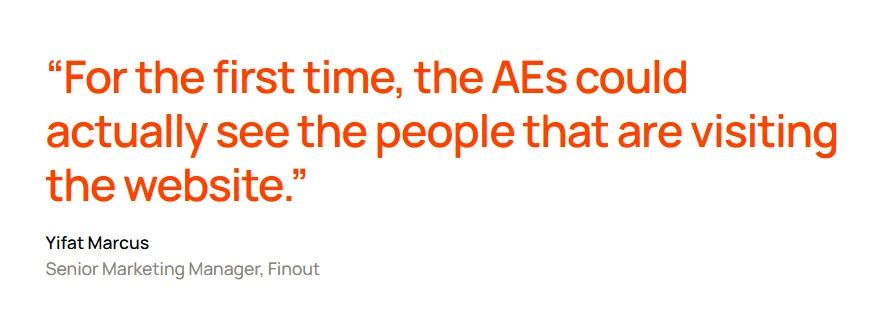
Swan is the product we build, and visitor identification runs inside it, so this workflow is our daily work. At Finout, Swan sorts website visits by intent and tags the AE who owns each account in Slack. Finout credits Swan with influencing over half of its pipeline. Forty people at Finout have used Swan, spanning marketing, sales, RevOps and GTM engineering.
Swan is our product, so it’s ranked first. For every other tool, we say plainly who it fits better. We checked features and prices on each vendor’s own site in November 2026.
What Is Website Visitor Identification Software?
Website visitor identification software puts a name on traffic that never converts through a form. You add a short snippet to your site. Each session is then compared against IP, browser and identity data to find the business or person behind it.
The result comes in one of two forms:
- Company-level match: You learn which business the visitor works for, plus the pages they viewed. This works in most countries because it relies on IP-to-company data.
- Person-level match: You also get a name, job title and often a LinkedIn profile or work email. This works best on US traffic, where identity data is deepest.
Expect a partial picture, not a full guest list. Warmly’s own production data puts typical US match rates at about 65% for companies and about 15% for people. Traffic from home networks, mobile devices and other countries resolves less often.
Why Is Website Visitor Identification Software Important?
Buyers research quietly. Visitor identification turns that research into something each GTM team can use:
- Sales hears about interest while it’s fresh. A visit to your pricing page matters most in the next few hours, not next week.
- Reps work the right accounts first. Repeat visits from an ICP account are a stronger reason to call than a cold list, and they power signal-based outbound.
- Marketing measures pages by the accounts they attract. You can judge a campaign by which target companies it brings in, not just raw traffic.
- Customer success catches expansion interest. A customer reading about a feature they don’t own is worth a timely conversation.
- Closed-lost deals get a second look. An old opportunity returning to your site is often a better lead than a new name.
5 Best Website Visitor Identification Software Tools
| Tool | Match level | Signals covered | What happens after a match | Pricing |
|---|---|---|---|---|
| Swan | Person and company, with company matches outside the US | Website visits, plus CRM history and account signals in the Brain | Filters, enriches and checks the CRM, then alerts, updates records or drafts outreach | Usage-based credits, free trial |
| RB2B | Person (US only) and company (global) | Website visits | Slack or Teams alerts, CRM sync, push to other apps | Free plan, paid from $79/mo |
| Warmly | Person and company | Website, CRM and product data, with intent, hiring and funding signals as an add-on | AI chat, alerts, routing, email, LinkedIn and ad retargeting | From $10,000/yr |
| Leadfeeder | Company (people only when they identify themselves) | Website visits and 33 trigger events | Alerts, CRM sync, B2B display ad campaigns | Free plan, paid from $79/mo billed annually |
| Common Room | Person (US, via Vector) and company | Website, product, community, job changes and third-party intent | Alerts, AI-drafted messages, sequences through your SEP | From $2,500/mo billed annually |
1. Swan: Best for teams that want to act on a visit, not just see a company name
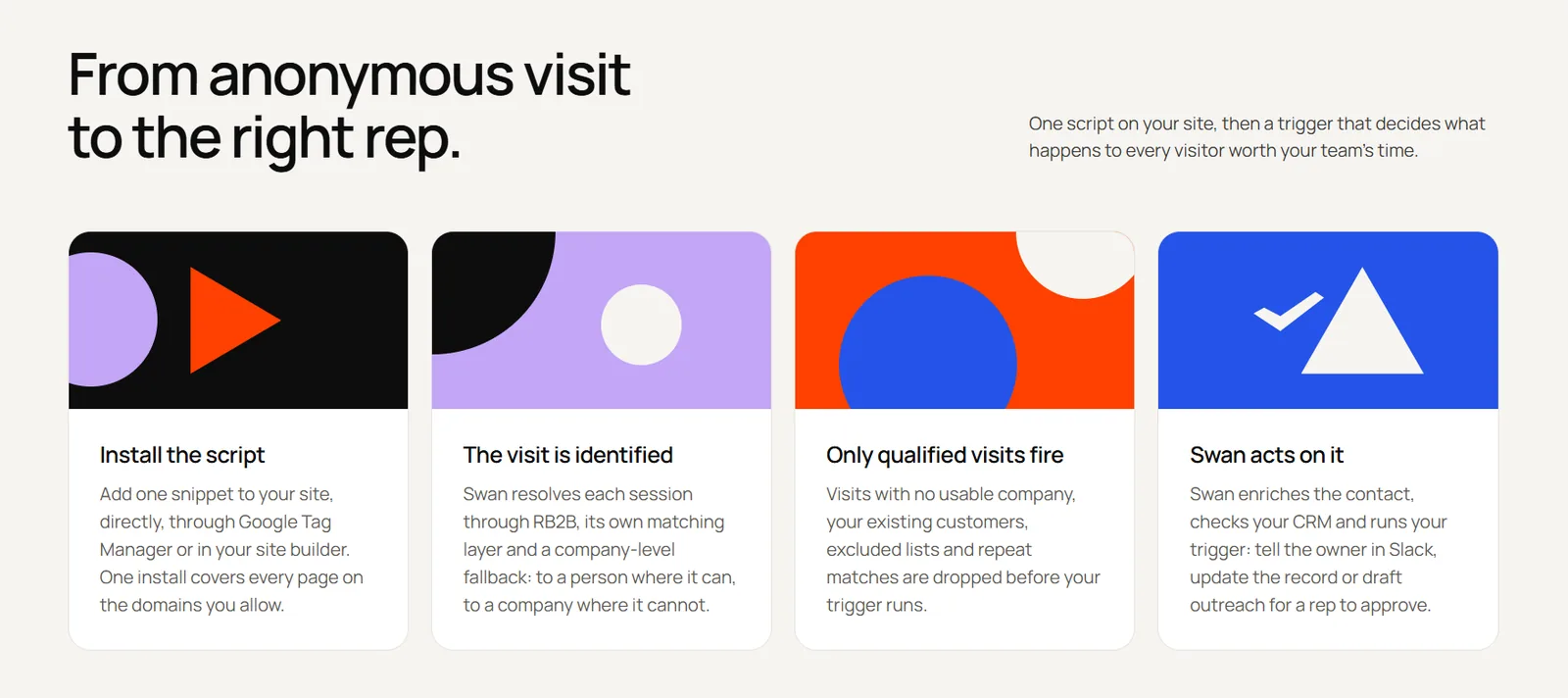
As an AI GTM engineer, Swan treats a website visit as the start of the work. Identification ships inside its tracking script, so there’s no second visitor ID vendor to manage. Swan’s website visitor identification page shows the full flow.
Each session runs through three matching paths. RB2B’s pixel is bundled into Swan’s script and delivers US person-level matches almost as they happen. Swan’s own matching layer maps IP addresses to companies and, given enough signal, to a LinkedIn profile. A slower company-level pass handles the rest, non-US traffic included. RB2B is one of those sources, so Swan builds on its person-level matches rather than replacing them. The difference is what happens after the name.
Swan drops visits your team can’t work before anything fires. That covers customers on a CRM exclude list, companies you’ve excluded, Swan’s built-in blocklist and repeat matches within about 20 minutes. The visits that remain are enriched, matched against HubSpot or Salesforce and run through a play you wrote in natural language. A play might post the visit in Slack for the account owner along with the pages viewed. It might update the CRM record or build an email and LinkedIn sequence. By default, that sequence waits for a rep to approve it.
Finout runs this motion today. Swan splits visits into five groups: high intent, low intent, competitors, partners and customers. HubSpot ownership decides which AE gets tagged in Slack. In one case, an AE saw the alert, reached out on LinkedIn and had an open opportunity by the end of the day.
The context also outlives the alert. Swan reads the Brain, its shared GTM brain of accounts, contacts, call notes and company knowledge, before every run. It writes back what it learns, and every account keeps a memory file. So the next play on that account starts with what Swan already knows. Sales gets a next step and marketing sees which target accounts its pages attract. CS can run its own play when a customer account comes back to look at paid features.
Key Features
- Three matching paths: Name the person when the data allows, and fall back to the company when it doesn’t.
- Filters before the trigger: Limit tracking by country, skip specific paths, require a minimum session length and apply CRM exclude lists.
- Enrichment and CRM checks: Fill in missing names and titles with contact data enrichment, then see whether the account is new, open or already a customer.
- Natural-language plays: Write the steps for a qualified visit in natural language, without an engineering ticket or node diagram.
- Approval by default: Review, edit or reject each sequence in the app or in Slack before the first message goes out.
- Your own visitor IDs: Pass a product or CRM ID with the script so the session links back to someone already in your systems.
Pricing
Swan bills in usage-based credits, and visitor identification is included rather than sold separately. A free trial is available. You can also set a daily identification limit to keep credit use in check.
Pros
- Visitor identification comes with Swan, so you don’t buy or maintain a separate visitor ID tool.
- Non-US visits still resolve to a company through the fallback path.
- Customers on your exclude lists, blocked companies and duplicate visits never reach your reps.
- Every qualified visit is enriched and checked against your CRM before it reaches a rep.
- Outreach drafts wait for approval unless you tell Swan to send a sequence automatically.
- What Swan learns goes back into the Brain, where sales, marketing and CS see the same account context.
Cons
- Person-level matches are strongest on US traffic, and visits the faster paths miss can take up to two hours to resolve.
2. RB2B: Best for small US teams that want names in Slack on a budget
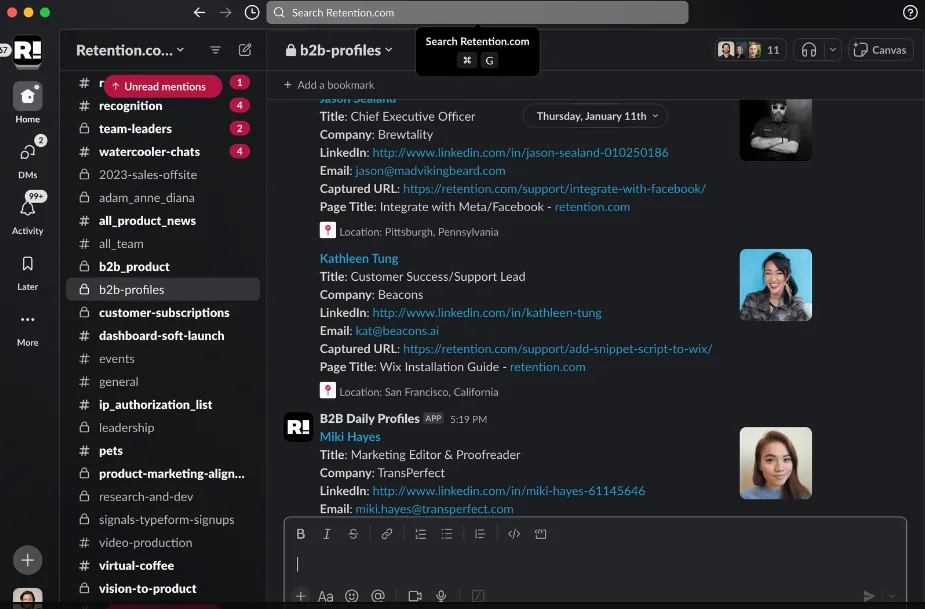
RB2B focuses on one fast handoff: a named visitor posted to Slack or Microsoft Teams. Person-level matching covers US visitors only. Company-level matching works globally through a partnership with Demandbase and reverse-IP lookup.
Plans scale by resolutions, which means identified visitors delivered to you. RB2B puts coverage at 15% to 20% of traffic on Pro. Pro+ adds its Identity Graph Waterfall and raises that to 35% to 45%. RB2B doesn’t research visitors or send outreach itself, so most teams pipe its matches into tools like Clay, Instantly or HeyReach.
Key Features
- Hot Pages: Mark visitors who land on pages you flag as high intent.
- Hot Leads: Filter visitors by your ICP and route each segment to a different destination.
- Exclusions: Leave out domains, URLs and lists you don’t want to see.
- Integrations: Send matches to HubSpot, Salesforce, Clay, Zapier, webhooks and more on Pro and Pro+.
Pricing
Plans listed on RB2B’s pricing page:
- Free: $0/mo for company-level ID pushed to Slack, capped at 150 resolutions monthly.
- Starter: $79/mo for person-level LinkedIn URLs in Slack or Teams, with 300 resolutions a month.
- Pro: From $149/mo, adding business emails and all integrations, from 600 resolutions a month.
- Pro+: From $199/mo for Premium Resolution, from 600 resolutions a month.
Every account starts with a seven-day trial that includes all features. Extra resolutions cost 45¢ each on Starter and 25¢ each on Pro and Pro+.
Rating
- G2: 4.5/5 (285 reviews)
- Capterra: 3.0/5 (2 reviews)
Pros
- You can try company-level matching for free before committing to a paid plan.
- Person-level names start at $79 a month, among the lowest entry prices on this list.
- Setup takes minutes, and matches start arriving in Slack right away.
Cons
- Person-level identification only works on US traffic.
- The higher coverage figures require Pro+, while Pro covers 15% to 20% of traffic.
- There’s no research or outreach built in, so you’ll need other tools to act on a match.
3. Warmly: Best for teams that want AI chat and ads to greet identified visitors
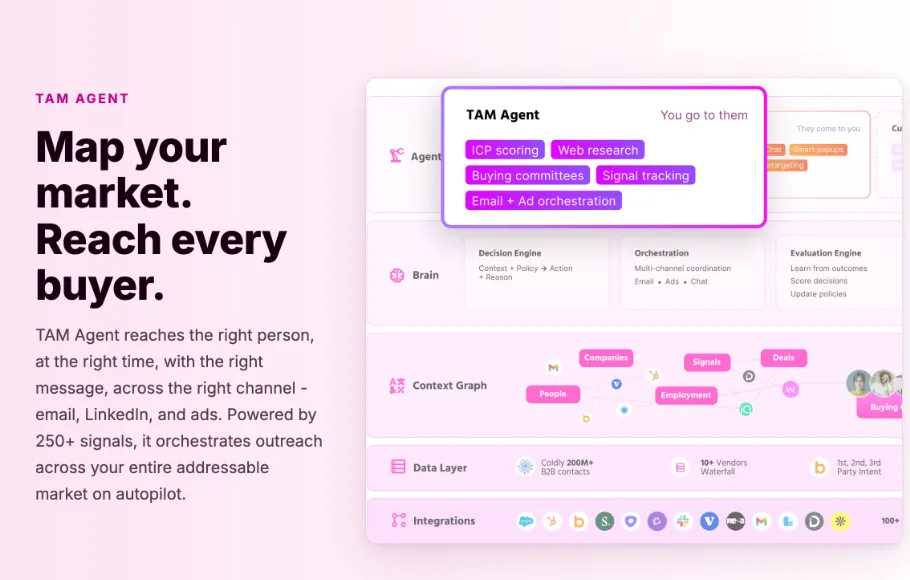
Warmly sells autonomous revenue agents for B2B GTM teams. It identifies visitors at the person and company level, then engages them while they’re still browsing. Its own use-case page puts identification at 15% to 30% of visitors.
Warmly’s Context Graph logs site visits, emails, CRM activity and chat logs in one place. It draws on 220M+ people profiles. From there, an AI chatbot can greet a known visitor, alert a rep or route the lead. Warmly also retargets visitors through email, LinkedIn and ads. Deeper intent, hiring and funding signals come in a separate GTM Signals Package.
Key Features
- AI Web-Deanonymization: See which people and companies are on your site, filtered by ICP and synced to your CRM.
- AI chatbot: Open a chat with context on the visitor’s identity and browsing history.
- Lead routing and alerts: Send high-value visitors to the right rep in real time.
- Retargeting: Reach identified visitors again through email, LinkedIn and ad audiences.
Pricing
Annual plans listed on Warmly’s pricing page:
- AI Web-Deanonymization: From $10,000/yr
- Inbound Chat: From $20,000/yr
- AI Inbound Autopilot: From $30,000/yr
- Add-ons: GTM Signals Package and Warm Experiences cost $10,000/yr each.
Quarterly billing costs more.
Rating
Pros
- An AI chatbot can greet identified visitors while they’re still on your site.
- One visit can trigger chat, routing, email, LinkedIn and ad follow-up.
- The Context Graph keeps visits, emails, chats and CRM activity together.
Cons
- Plans begin at $10,000 a year billed annually, and buying starts with a sales demo.
- Intent, hiring and funding signals cost another $10,000 a year.
- Some G2 reviewers report inaccurate visitor matches.
4. Leadfeeder: Best for teams with European traffic that need company-level account tracking
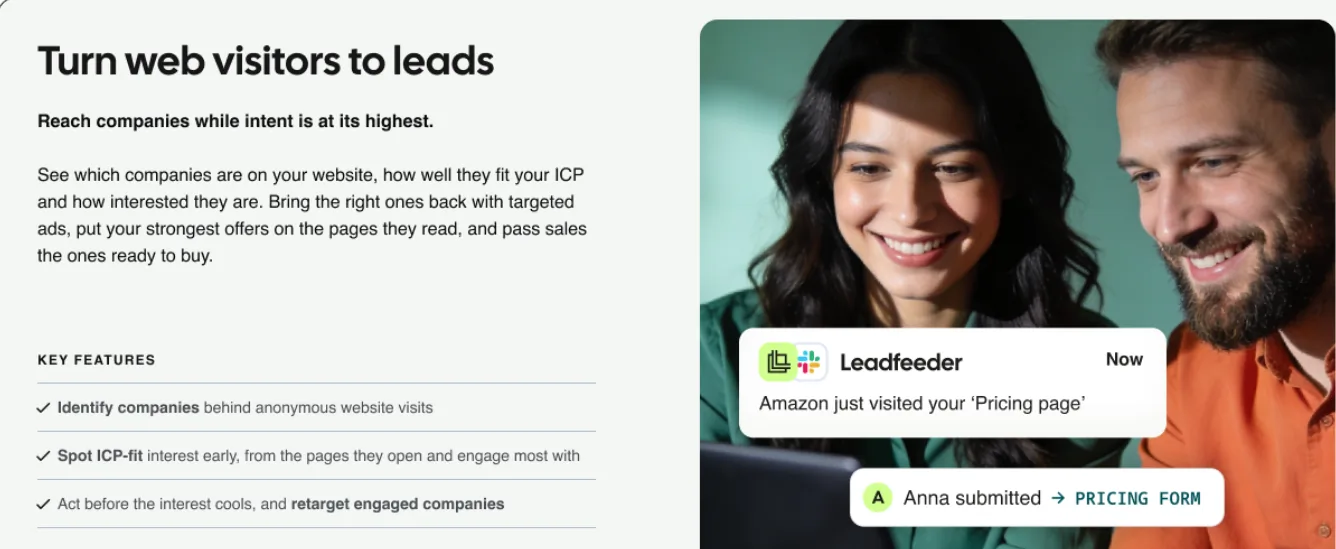
Leadfeeder, part of Dealfront Group, shows the companies behind your traffic and scores them by ICP fit and intent. It claims to identify up to 45% of B2B visitors at the company level. Individual visitors stay hidden by default. You only see a person once they identify themselves, for example through a form or an email integration.
Leadfeeder’s strength is account context. It tracks 33 trigger events, like hiring, funding, partnerships and website updates. Contact data, CRM automations and display ad campaigns start on the Activate plan. Email outreach happens in other tools.
Key Features
- Web Visitors: Browse the companies on your site, each with an ICP fit score and page history.
- Web Insights: Find out which sources and campaigns attract your target accounts.
- Alerts and CRM sync: Get real-time alerts and push companies to HubSpot, Salesforce, Pipedrive and other CRMs.
- API and MCP access: Pull Leadfeeder data into your own systems and AI tools from Discover up.
Pricing
Plans listed on Leadfeeder’s pricing page:
- Lite: Free, showing your most recent 100 companies each month and seven days of history.
- Discover: From €79/mo billed annually (€113 billed monthly) for up to 50 identified companies a month.
- Activate: From €369/mo billed annually (€527 billed monthly) for 1,000 companies and 200 credits a month.
- Scale: From €599/mo, billed annually only.
Every plan includes unlimited users, and you can trial paid plans for 14 days.
Rating
- G2: 4.3/5 (871 reviews)
- Capterra: 4.2/5 (136 reviews)
Pros
- The free Lite plan and unlimited users make it easy to roll out across a team.
- Trigger events add context, like funding or a new hire, to a company visit.
- Its GDPR focus is a good fit for sites with heavy European traffic.
Cons
- Anonymous visitors only ever appear as companies.
- Contact data, campaigns and CRM automations start at $369 a month on Activate.
- Follow-up emails have to be written and sent elsewhere.
5. Common Room: Best for teams whose buyers also show up in product and community data
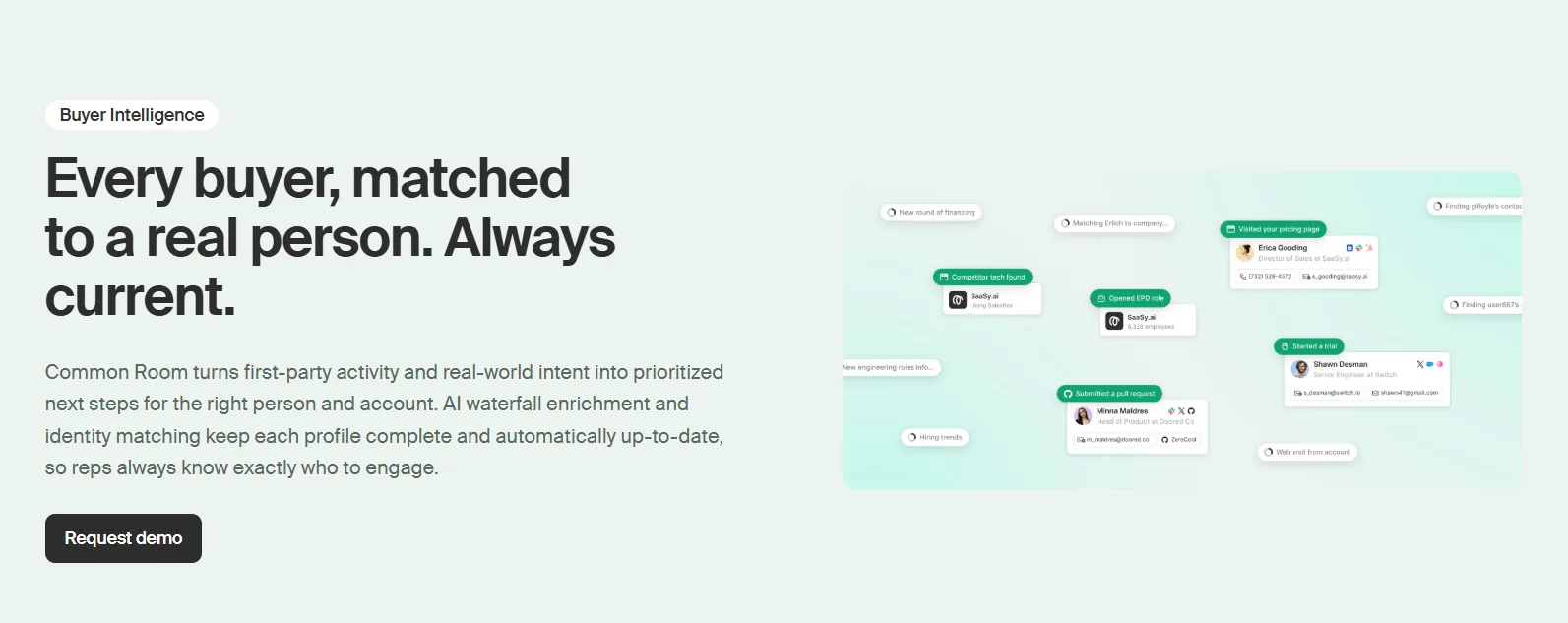
Zoom announced in July 2026 that it would acquire Common Room, a buyer intelligence platform. Its Person360 engine pulls web visits, product usage, community activity, CRM records and job changes into one profile per person.
On your website, standard tracking identifies visits globally. For US traffic, an enhanced option powered by Vector adds up to 50% person-level visibility, with 1,000 Vector credits a month included at no cost. Common Room’s docs say tests show 60% to 75% accuracy for Vector’s contact-level data. RoomieAI can then draft messaging from web activity and other signals. You can enroll prospects into sequences through your sales engagement platform.
Key Features
- Person360: Tie website, product and community activity to a single record per buyer and account.
- Enhanced US visitor tracking: Route US traffic through Vector for more person-level matches.
- RoomieAI: Use AI agents to research accounts and draft outreach based on signals.
- Third-party intent topics: Track 6, 12 or 25 intent topics, depending on your plan.
Pricing
Plans listed on Common Room’s pricing page:
- Essential: $2,500/mo billed annually, with 5 seats, up to 100k contacts and 1k website deanonymizations a month.
- Advanced: Custom pricing, with 15 seats, up to 250k contacts and 1k deanonymizations a month.
- Enterprise: Custom pricing, with 30 seats, up to 750k contacts and unlimited deanonymization.
Common Room doesn’t list a free plan or trial on its pricing page.
Rating
- G2: 4.5/5 (149 reviews)
- Capterra: 4.5/5 (3 reviews)
Pros
- Enhanced US tracking adds up to 50% person-level visibility.
- Web visits sit next to product, community and job-change signals in one profile.
- RoomieAI drafts messages from the signals Common Room captures.
Cons
- Essential, the cheapest plan, is $2,500 a month on an annual contract.
- Both Essential and Advanced limit deanonymization to 1,000 visits a month.
- G2 reviewers often mention a learning curve when they first set it up.
Selection Criteria
How We Evaluated
We judged every tool by what turns a visit into pipeline:
- Person vs company matching: How often can it go beyond the company to a named person, and where?
- Signals covered: Is the website its only input, or does it also track buying signals like job changes, product usage and intent data?
- What happens after a match: Is the output a simple alert, an updated CRM record or a next step with research behind it?
- Pricing transparency: We took every competitor price from the vendor’s own pricing page and noted free plans and trials.
- Controls: Can you exclude customers, filter by country and keep low-value visits out of your team’s feed?
How to Choose
Pick Swan if you want visits handled like inbound leads, with automated lead qualification, CRM checks and drafted outreach your reps approve.
Pick RB2B if you’re a small US team that mainly needs names in Slack and already has tools for outreach.
Pick Warmly if you want AI chat to engage visitors on the page and you have a five-figure annual budget.
Pick Leadfeeder if a large share of your visitors are in Europe and company-level visibility is enough.
Pick Common Room if your buyers also leave signals in your product, community or open-source projects.
Turn Website Visits Into Next Steps With Swan
Every tool here can tell you someone visited. They differ on what comes next. RB2B and Leadfeeder hand you the match and leave the rest to your team. Warmly and Common Room add engagement tools at higher prices.
Swan carries the visit through. It filters out noise and checks your CRM. Then it drafts a next step for a rep to approve and writes what it learned back to the Brain. Sales, marketing and CS then pick up from one shared account record.
See who visited your site last week and what Swan would do with each visit.
FAQs
Can I See Exactly Who Visited My Website?
For part of your traffic, yes. Most tools can name the company behind many B2B visits. Person-level names work mainly on US traffic, and every tool misses some visitors.
What Is the Difference Between Company-Level and Person-Level Identification?
Company-level identification tells you which business a visitor works for, usually from their IP address. Person-level identification also gives you the individual’s name and title. It reaches fewer visitors and works best in the US.
How Accurate Is Website Visitor Identification Software?
It depends on your traffic. Office networks resolve better than home, mobile or international visits. Treat vendor match rates as best-case figures and judge tools by visits your team can act on.
Is Website Visitor Identification Legal?
Generally yes, if you follow the privacy laws where your visitors are and your privacy policy discloses the tracking. GDPR rules in Europe are stricter, so many tools limit person-level matching to US traffic. Ask your legal team to review the setup before the script goes live.
Is There Free Website Visitor Identification Software?
Yes, at the company level. RB2B’s free plan sends up to 150 company-level matches a month to Slack. Leadfeeder’s Lite plan lists your latest 100 companies each month. Swan offers a free trial if you want to test the full path from visit to outreach.