
Playbooks· 16 min read
We Compared the 5 Best AI Tools for Sales Prospecting in 2026
Compare AI prospecting tools on research depth, signals covered and what happens after a match. See where Swan, Clay, Apollo, Amplemarket and 11x fit.
 Amos Bar-JosephCo-Founder & CEO ·
Quick Summary
The best AI tools for sales prospecting are Swan, Clay and Apollo.io. All five tools in this guide can find accounts that fit your ICP. Where they split is what happens next. Swan researches each matched account and drafts outreach for your team to approve. Clay gives GTM engineers the parts to build their own flow. Apollo.io puts data and sequences in one low-cost app. Amplemarket and 11x suit teams that want a full platform or an autonomous AI SDR.
| Tool | Best For | Starting Price | G2 Rating |
|---|---|---|---|
| Swan | A researched draft for every signal | Usage-based credits, free trial | Not yet rated |
| Clay | GTM engineers who build their own workflows | Free; Launch $167/mo billed annually | 4.6/5 |
| Apollo.io | Data and sequences in one app | Free; Basic $49/user/mo billed annually | 4.7/5 |
Finding the Account Is the Easy Part
Most AI prospecting tools can now tell you which accounts fit your ICP (ideal customer profile). Many can also show you which of those accounts are visiting your site, hiring or raising money. Finding the account is no longer the hard part.
The hard part comes after. Someone still has to research the account, pick the right person and write a message worth replying to. In Salesforce’s State of Sales report, reps say they spend 70% of their time on non-selling tasks. Research and first drafts make up a big share of it.
So we compared five tools on three questions. How deep does the research go? Which signals does the tool watch? And what does it actually do once an account matches? The answers tell you how much work lands back on your team.
Why Listen to Us?
Swan is our product, and it takes the top spot on this list. Our team works closely with GTM teams on their prospecting workflows every day, so we see which tools carry the work through and which leave the hard parts to reps.
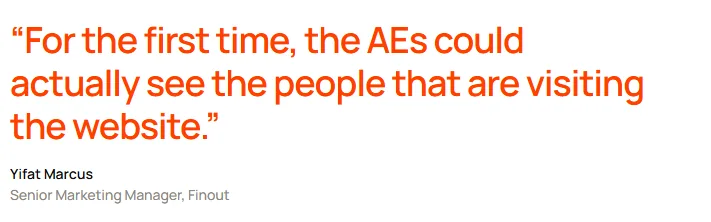
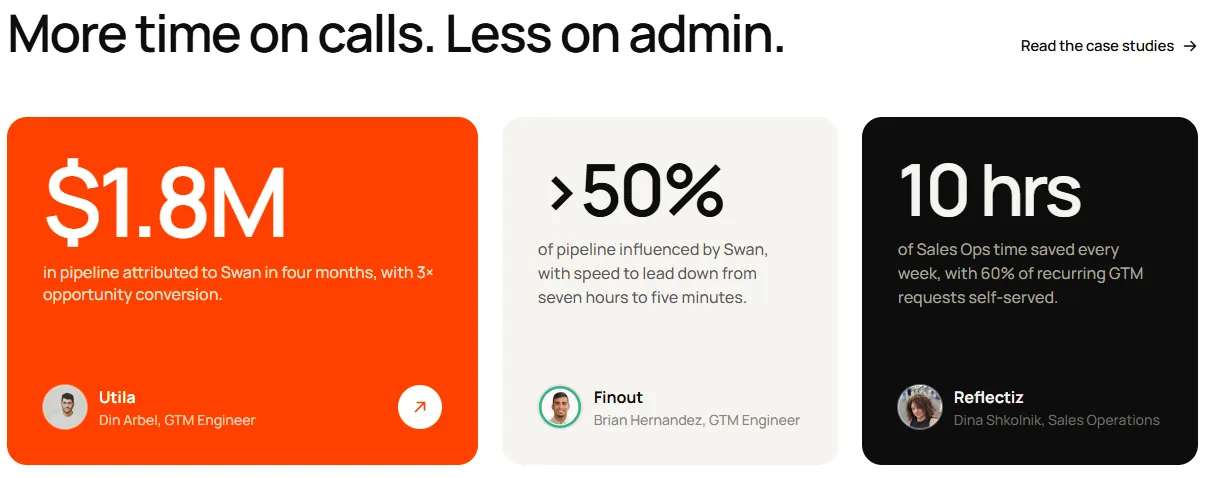
Results from GTM teams using Swan back the approach. Utila credits Swan with $1.8M in pipeline in four months, across 37 opportunities. Finout cut the time from form fill to outreach sequence from a seven-hour median to five minutes.
For the other four tools, we checked every feature and price against the vendor’s own site, and every rating against G2, in November 2026.
What Are AI Tools for Sales Prospecting?
AI tools for sales prospecting are software that find, research and reach potential buyers. They take over steps a sales development rep (SDR) would do by hand, like building lists, digging into accounts and writing first emails.
The category is broad. It covers contact databases with AI features, workflow builders, copilots and fully autonomous AI SDRs. To compare them fairly, we looked at three things:
- Research depth: What the tool learns about an account before anyone reaches out. Basic tools stop at company size and job title. Deeper ones read news, hiring data, past emails and CRM history.
- Signals covered: Which buying moments the tool watches. Common examples are website visits, job changes, funding rounds, hiring spikes and G2 research.
- What happens after a match: What the tool does once an account fits your ICP and shows a signal. Some add a row to a list. Some send a Slack alert. A few research the account and draft the outreach.
That last question matters most. It decides whether your reps start from a blank page or from a draft.
Why Are AI Tools for Sales Prospecting Important?
- Reps get selling time back: Account research and first drafts are the slowest parts of prospecting, and AI handles both well.
- You reach buyers while they’re still looking: A pricing-page visit loses value fast. A good tool acts on it the same day, not the next week.
- Outreach has a reason behind it: A message that mentions new funding or a recent hire reads like real homework.
- Pipeline grows without new hires: One rep can cover far more accounts when research and drafting are done for them.
- Context stays in one place: Good tools log what they find, so the next rep doesn’t start from zero.
5 Best AI Tools for Sales Prospecting Compared
We ranked these five by how much prospecting work each one takes off your team’s plate:
| Tool | Research Depth | Signals Covered | After a Match | Starting Price |
|---|---|---|---|---|
| Swan | Deal history, past threads and org chart in one brief; 40+ data providers | Site visits, G2 and third-party intent, job changes, funding, hiring, closed-lost revivals | Drafts emails and LinkedIn notes for one-tap approval in Slack | Usage-based credits, free trial |
| Clay | Claygent web research on any question you define | Job changes, new hires, web and topic intent, tech stack changes, news | Whatever workflow you build: alerts, CRM updates or sequences | Free; Launch $167/mo billed annually |
| Apollo.io | AI Research Agent on its own contact and company data | Buying intent topics, website visitors | Contacts go into multichannel sequences | Free; Basic $49/user/mo billed annually |
| Amplemarket | Duo research agents explain the context behind each signal | Job changes, funding, hiring, competitor G2 reviews, community posts | Duo drafts a multichannel sequence for the rep to send | Startup $600/mo, annual term |
| 11x | Deep Research reports with source citations | Job changes, funding, hiring, tech adoption, site visits, review-site research | Alice writes and sends, with review modes or autopilot | Growth from $3,750/mo billed annually |
1. Swan: Best for teams that want every signal researched and drafted
Swan is the AI GTM engineer that researches accounts and drafts outreach from what it finds. It watches your accounts for buying signals, builds the context behind each one and writes the first message for your team.
Research starts the moment a signal fires. Swan pulls deal history, past email threads and the account’s org chart into one brief, and it takes under a minute. It then maps the likely buying committee and finds verified contact details for each person.
Swan covers signals on both sides of the funnel. Its intent-based prospecting picks up pricing-page visits, third-party intent surges and repeat visits. On the outbound side, it tracks champion job changes, funding rounds, hiring spikes and closed-lost deals that come back to life.
After a match, Swan writes account-specific emails and LinkedIn notes in your voice. Each draft lands in Slack, where a rep can approve it in one tap, edit it or dismiss it. By default, nothing goes out until a person signs off. That’s how Swan runs signal-based outbound without losing the human check.
Key Features
- Website visitor identification: The Swan pixel resolves anonymous visits, such as pricing-page views, to the accounts behind them.
- Fit and intent scoring: Every in-market account lands in one ranked queue, refreshed daily.
- Buying committee mapping: Swan finds the likely decision-makers at each account, with verified contact data.
- Waterfall enrichment: Each field is checked across 40+ data providers, and you only pay when one returns a result.
- Slack approvals: Drafts arrive in Slack with Approve and Deny buttons, so review takes seconds.
- Plain-English plays: Describe a play in plain English, then set a trigger so Swan runs it on every new signal.
- Stack integrations: Swan connects to HubSpot, Salesforce, Pipedrive, Attio, Outreach and Gong, among others.
Pricing
Swan uses usage-based credits, so you pay for the GTM work it does, like research, enrichment and outreach. Annual billing saves up to 20% and new accounts get a 14-day free trial. Current plans are on the pricing page.
Pros
- Every draft points to the signal behind it, so the first message gives the buyer a reason to reply.
- One AI GTM engineer covers inbound and outbound signals, from site visits to closed-lost revivals.
- Research and drafting take under a minute after a signal fires, while the buyer is still looking.
- Approval is on by default, so your team sees every first touch before it goes out.
- Pay-per-result enrichment means empty lookups don’t use credits.
Cons
- With approval on by default, someone needs to check Slack daily so drafts don’t sit.
2. Clay: Best for GTM engineers who want to build their own system
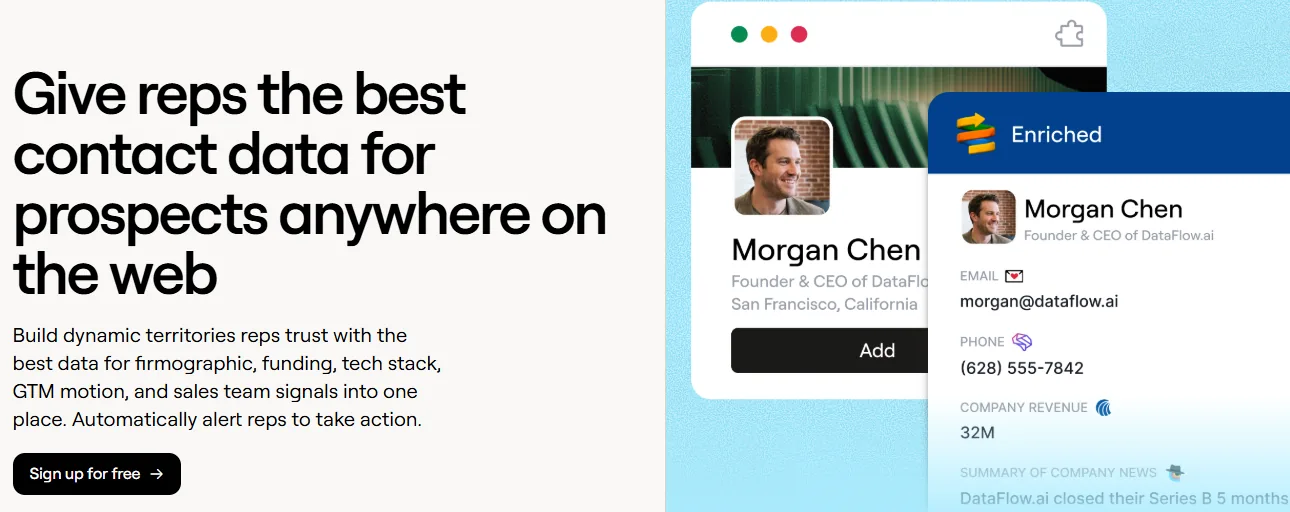
Clay is a GTM data and workflow platform. GTM engineers use it to build prospecting systems from tables, enrichment providers and AI agents.
Its research can go very deep, because Claygent, Clay’s AI agent, runs live web research and returns structured answers to the questions you write. Clay’s signal list is also wide. It covers job changes, new hires, web intent, topic intent, tech stack changes, news and social listening.
After a match, you decide what happens. Clay can alert a rep in Slack, update CRM records, queue AI-written emails or send through its own sequencer. But someone on your team has to build each of those workflows and keep them running.
Key Features
- Claygent: Point an AI agent at any research question, like a competitor’s homepage, and get a structured answer back.
- Signals: Track job changes, new hires, web intent, tech stack changes and news in one place.
- Multi-provider waterfalls: Check several data providers in turn until one returns the field you need.
- Clay Sequencer: Send email outreach from the same place your data lives.
Pricing
- Free: $0, with 500 actions and 100 data credits a month
- Launch: $167/mo billed annually, or $185 billed monthly
- Growth: $446/mo billed annually, or $495 billed monthly; adds CRM sync and web intent
- Enterprise: Custom pricing
Every plan includes unlimited seats.
Pros
- Claygent can answer niche research questions that a fixed contact database can’t.
- Unlimited seats on every plan make it easy to bring the whole team in.
- Its signal list goes beyond the basics, with tech stack changes and social listening.
Cons
- CRM sync and web intent signals start on the $446/mo Growth plan.
- Each workflow needs a technical owner to build it and keep it running.
- Free plan tables cap at 200 rows, which limits real testing.
3. Apollo.io: Best for data and sequences in one app
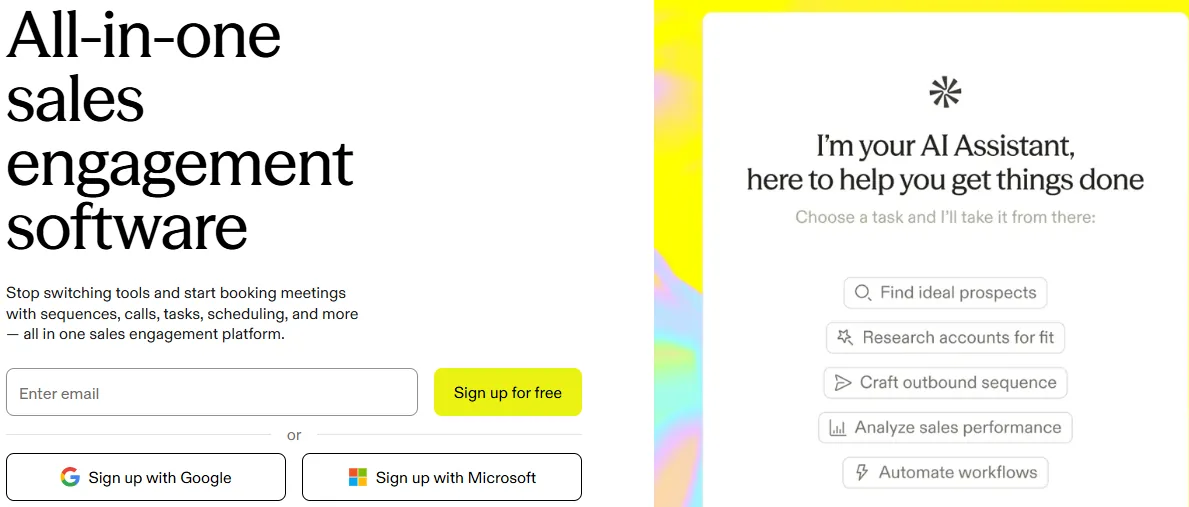
Apollo.io is a sales platform built on its own database of 240M+ contacts and 30M+ companies. It’s an easy first step, since you can find a contact and email them without leaving the app.
Its research runs on that database. The AI Research Agent, on the Professional plan, adds AI-researched details to records. For signals, Apollo offers buying intent topics and website visitor identification, which matches your traffic against its contact data.
After a match, contacts go into multichannel sequences across email, phone, social and tasks. That works well for volume, though your team still decides what each message says about the account. We’ve also put Clay and Apollo side by side if you’re choosing between the two.
Key Features
- AI Research Agent: Fill records with AI-researched details, on the Professional plan and up.
- Buying intent topics: Track accounts researching topics you choose, from Apollo’s list of 15K+ topics.
- Website visitor identification: Match site traffic to companies and contacts in Apollo’s database.
- Multichannel sequences: Run email, phone, social and task steps in one sequence.
- Power and Parallel Dialer: Call prospects from inside Apollo, starting on Professional.
Pricing
- Free: $0
- Basic: $49/user/mo billed annually
- Professional: $79/user/mo billed annually
- Organization: $119/user/mo billed annually, with a 3-seat minimum
Pros
- One subscription covers contact data, enrichment and sequences.
- The free plan lets you test the data before you pay.
- Public per-seat pricing makes budgeting simple.
Cons
- AI research and the dialer start on the $79/user/mo Professional plan.
- Basic limits you to 6 intent topics.
- Credits don’t roll over, and costs rise with every seat you add.
4. Amplemarket: Best for an all-in-one platform with a copilot
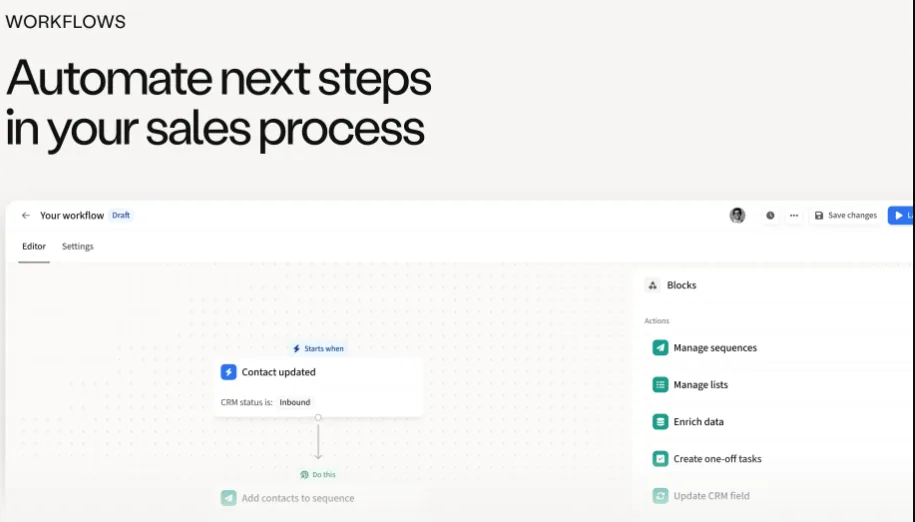
Amplemarket is an all-in-one sales platform with B2B data, AI agents, multichannel sequences and a dialer built in. Its copilot, Duo, comes closest to Swan’s approach among the other tools here.
Duo’s research agents gather the context behind each signal, so the rep knows who they’re contacting and why. Its signal list is broad. It tracks job changes, funding, hiring, website visits, competitor reviews on G2 and posts in Slack communities. Teams can also add custom signals from their CRM.
After a match, Duo surfaces the person, not just the account, and drafts a multichannel sequence. The rep can edit it, regenerate it, send it or dismiss it. Duo doesn’t send anything on its own. The catch is scope: you’re buying a full platform, with its own database and sequencer.
Key Features
- Duo Copilot: Get people to contact each day, with a drafted sequence for each one.
- Duo Accounts: See key company context and recent activity in one view.
- Intent signals: Catch job changes, competitor research, community posts and website visits.
- Multichannel sequences and dialer: Run email, phone and social steps, plus calls, from one platform.
- Domain Health Center: Check your sending domains before outreach goes out.
Pricing
- Startup: $600/mo on an annual term, for 2 users
- Growth: Custom pricing, for 4 users
- Elite: Custom pricing, for 10 users
Every plan includes a free trial.
Pros
- Duo finds the person showing the signal, not just the company.
- Reps start from a finished multichannel sequence instead of a blank page.
- Community and competitor-review signals can catch buyers before they visit your site.
Cons
- Startup is the only plan with a public price, and it needs an annual term.
- Duo Voice isn’t listed on Startup, and Duo Inbox sits on the higher plans.
- It overlaps with any database or sequencer you already pay for.
5. 11x: Best for handing outbound to an AI SDR
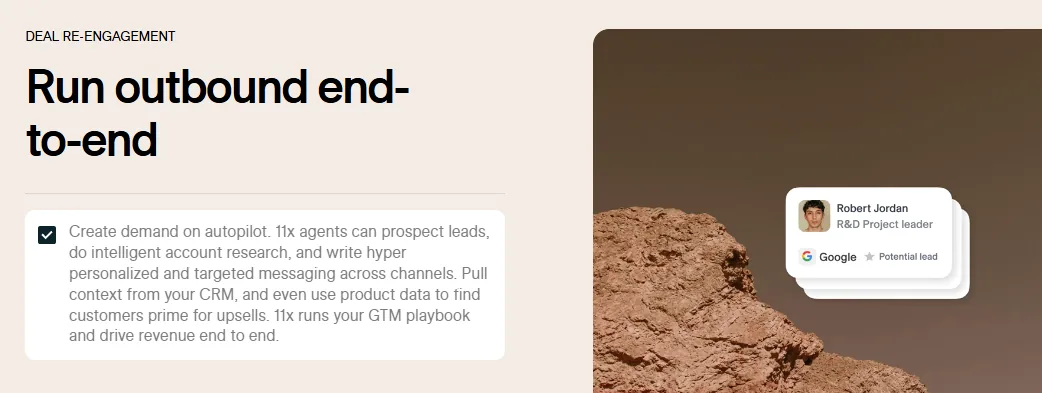
11x builds AI agents for revenue teams, and Alice is its AI SDR for outbound. Alice runs a four-step loop: identify, research, personalize and engage.
Her research is detailed. Deep Research pulls from the web, news, job postings, company announcements and your CRM history. It returns a report with source citations and a suggested angle for the message. Alice watches job changes, funding, hiring, tech adoption, website visits and review-site research.
After a match, Alice writes the outreach and runs sequences across email, calling, LinkedIn, SMS and WhatsApp. You can review every message, set an approval step or let Alice run on autopilot. 11x is the most hands-off tool on this list, and it’s priced that way. If the cost doesn’t fit, here are some 11x alternatives.
Key Features
- Deep Research: Get a cited research report on each prospect, with a recommended messaging angle.
- Signals and Triggers: Turn intent events into plays that start on their own.
- Website visitor tracking: Identify the companies behind anonymous site traffic.
- Qualification Agent: Check each prospect for ICP fit before any outreach goes out.
- Smart Replies: Sort replies, draft responses and pass anything tricky to a human.
Pricing
- Growth: From $3,750/mo billed annually, for up to 5 users and 2,000 new prospects a month
- Pro: Custom pricing, for up to 10 users and 5,000 new prospects a month
- Enterprise: Custom pricing, for unlimited users and 10,000+ prospects a month
11x charges per prospect, not per message sent.
Pros
- Deep Research reports cite their sources, so reps can check each talking point.
- Three review modes let you move from checking every message to full autopilot.
- Alice runs email, calling, LinkedIn, SMS and WhatsApp in a single sequence.
Cons
- Growth starts at $3,750/mo on annual billing, which rules out most small teams.
- Growth caps you at 2,000 new prospects a month.
- Julian, the inbound agent, is priced separately from Alice.
Selection Criteria
How We Evaluated
We scored each tool on the three questions from earlier: research depth, signals covered and what happens after a match. We gave the most weight to the last one, because it decides how much work your team still has to do.
We also looked at two practical points. First, is pricing public, and what does it take to get started? Second, how much control do you keep over what gets sent? Every feature and price was checked against the vendor’s own site in November 2026, and every rating against G2.
How to Choose
The best B2B prospecting tools for your team depend on who will own the work after a match:
- You have a GTM engineer who likes to build: Clay gives you the most building blocks and the widest signal list.
- You want data and sequences in one place on a budget: Apollo.io is the cheapest way in, with a free plan.
- You want a full platform with a copilot: Amplemarket drafts sequences for reps, if a $600/mo annual starting point fits.
- You’re ready to hand outbound to an agent: 11x makes sense if you can commit to annual billing from $3,750/mo.
- You want every signal researched and drafted, with your team approving each send: Swan covers inbound and outbound. You can try it free for 14 days.
Pick the Tool That Acts on What It Finds
Every tool on this list can find accounts that fit your ICP. The real difference is what each one does next. Some stop at a list or an alert. Others research the account and hand your reps a message worth sending.
Swan researches every matched account, drafts the outreach and keeps your team in control of every first touch.
Start the free trial and see what it drafts for your own accounts.
FAQs
What Are The Best B2B Prospecting Tools?
Swan, Clay and Apollo.io. Swan suits researched, signal-led outreach. Clay suits custom workflows, and Apollo.io puts data and sequences in one app. Amplemarket suits teams that want a copilot inside a full platform. 11x suits teams ready to hand outbound to an AI SDR.
What Is An AI Prospecting Agent?
An AI prospecting agent is software that carries out prospecting steps for you. It watches for signals, researches the matching accounts and drafts or sends outreach. Some agents, like 11x’s Alice, can send on their own. Others, like Swan, draft the message and wait for a person to approve it.
Can AI Prospecting Tools Replace SDRs?
AI prospecting tools can take over most of an SDR’s research and first drafts. They don’t replace judgment, relationships or live calls with buyers. Most teams use them so each rep covers more accounts. Finout, for example, says one SDR now has the impact of a team of five with Swan.
How Do You Use AI For Sales Prospecting?
Start by defining your ICP and the signals that matter most, like pricing-page visits or new funding. Connect your CRM so the tool can see deal history. Then let it research each match and draft the outreach. Review the first touches yourself until you trust the output.
What Is The Difference Between Account-Level And Contact-Level Intent?
Account-level intent tells you a company is researching a topic, but not who at the company is doing it. Contact-level intent points to a specific person, like a visitor you can identify or a champion who just changed jobs. Contact-level signals make outreach easier to aim.