
Playbooks· 16 min read
We Have Reviewed Five ZoomInfo Alternatives in 2026
Compare the top five ZoomInfo alternatives in 2026: Swan, Apollo, Cognism, Lusha, and Clay. See how each handles data, pricing, and outreach before switching.
 Amos Bar-JosephCo-Founder & CEO ·
Quick Summary
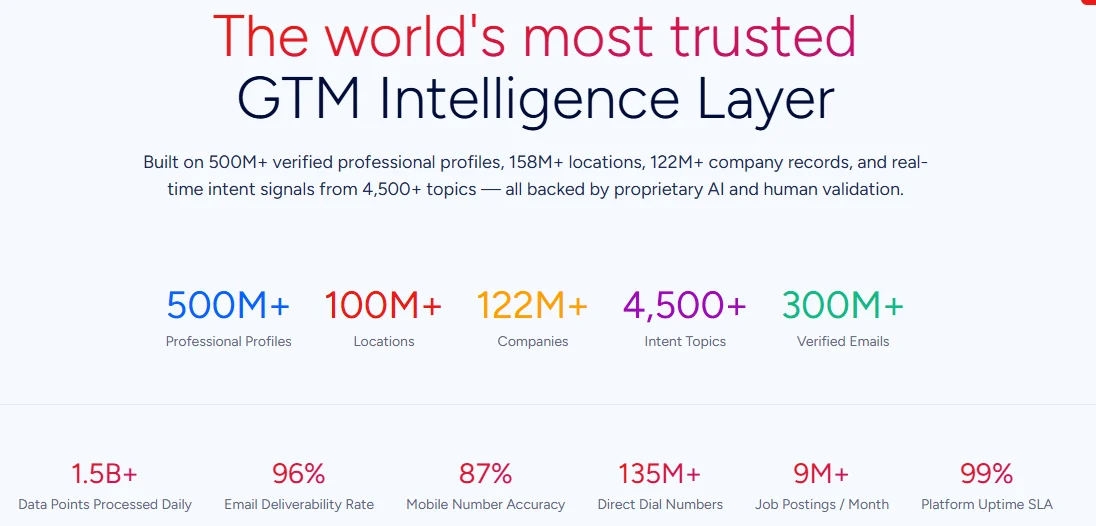
ZoomInfo runs one of the largest B2B databases, with 500M+ contacts and 122M+ companies. But it sells on custom annual contracts, reviewers keep flagging stale records, and your reps still research every account and decide what happens next.
The right alternative depends on which of those problems hurts most. A cheaper data tool fixes the bill. A regional specialist fixes coverage. A tool that researches signals and acts on them fixes the manual work. If it runs on a shared GTM brain, marketing and CS get the same context as sales.
We reviewed five ZoomInfo alternatives on price, data, signals, who does the work, and how much of the GTM org gets value.
Top 3 ZoomInfo Alternatives at a Glance
| Tool | Best for | Starting price |
|---|---|---|
| Swan | Teams that want signals turned into researched outreach | Usage-based credits, free trial |
| Apollo | Teams that want data, sequences, and calls in one tool | Free plan; paid from $49 per user a month, billed annually |
| Cognism | Teams that sell into Europe and call prospects | Quote only |
Paying for Data Your Team Still Has to Act On
ZoomInfo is built around a big database. You search it, pull a list, and hand it to your reps. That works when finding names is the hard part.
For most teams, it isn’t the hard part anymore. You pay through a custom quote and a yearly contract. Records go out of date between pulls. And a rep still has to open the account, check the CRM, and write the email by hand.
Swapping one database for another only solves part of that. So we asked one question about each alternative first. Does it cut the cost, the manual work, or both?
Why Listen To Us?
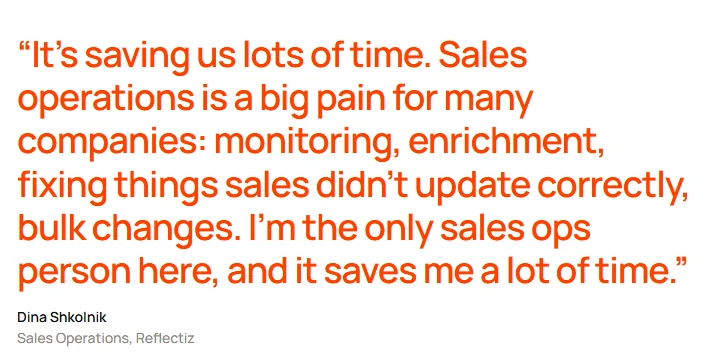
We build Swan, an AI GTM engineer, and we work closely with the revenue teams that use it. At Utila, sales, CS, and marketing tied $1.8M in pipeline to Swan in four months. Reflectiz now handles 60% of its recurring GTM requests without Sales Ops.
That work shows us where a database helps and where reps still do the job by hand. We used that lens on every tool below. Swan is one of the five, so we held it to the same standard and noted where it falls short.
What Is ZoomInfo?
ZoomInfo is a B2B data company that grew into a full sales and marketing stack. It began in 2007 as DiscoverOrg, and its stock now trades under the ticker GTM. Teams use it to look up buyers, enrich CRM records, watch intent, and run outreach from one login.
Scale is the draw. ZoomInfo says its database holds 500M+ contacts and 122M+ companies, and that 35,000+ companies buy from it. Copilot suggests who to contact, GTM Workspace gives sellers one place to work, and GTM Studio builds plays around signals. Marketing, Operations, and Talent products sit alongside them.
Breadth sells it, and breadth also pushes teams out. You pay for the whole stack on a custom contract, even when you only need one part: cleaner data, better coverage in one region, or a tool that sends the outreach. Each tool below fixes one of these problems.
Why Do Teams Look for ZoomInfo Alternatives?
ZoomInfo holds a 4.5 out of 5 on G2. Reviewers praise its contact information and ease of use. The same reviews also point to three recurring problems.
1. Custom Pricing and Annual Lock-In
ZoomInfo publishes no prices. Its pricing page sends you to a form for a custom package. API, MCP, and CLI access are usage-based, and data sent to a warehouse is contracted per dataset.
Capterra reviewers score value for money at 3.5 out of 5, the lowest of its sub-scores. ZoomInfo’s license terms say the agreement can’t be canceled before it expires. One Copilot reviewer cites automatic renewal with little notice and no monthly option.
2. Records Go Stale
On G2, the five most common cons tags are all about outdated or inaccurate data. ZoomInfo claims 96% email deliverability and 87% mobile accuracy, but it doesn’t say how it measured them. One G2 reviewer puts overall accuracy near 75% and says about half of phone numbers are wrong.
The contract’s accuracy guarantee is narrower than it sounds. It covers whether a contact is still tied to the stated company. It does not cover whether the email lands or the phone connects.
3. Data Without a Next Step
Intent data shows an account is interested. It doesn’t tell a rep what to do about it. G2 reviewers describe intent models that miscategorize accounts and signals that turn out to be false, with manual scoring fixes. Others report list pulls that miss contacts and CRM fields that need ongoing cleanup.
Between the pull and the send, someone still researches the account, finds an angle, and writes the message. Our guide to intent-based prospecting shows how teams take that work off their reps.
To be fair, ZoomInfo is working on this. Its newer GTM Studio plays and Agent Teams aim at action, not just data. On its Q2 2026 earnings call, it also said some buyers who left for cheaper tools have come back.
The Five ZoomInfo Alternatives Compared
Here is how the five tools differ on data, signals, sending, who does the work, and how far the value reaches across the GTM org.
| Tool | Own database | Signals | Built-in sending | Who does the research | Pricing model | GTM brain | Value across the GTM org |
|---|---|---|---|---|---|---|---|
| Swan | No, enriches through third-party providers | Site visits, LinkedIn, funding, hiring, intent, replies | Email and LinkedIn, with optional approval | Swan | Usage-based credits, free trial | Yes, shared memory of every deal, contact, and conversation | Sales, marketing, and CS work from one brain |
| Apollo | Yes, 240M contacts claimed | Company-level intent, job changes | Email and dialer | Your rep | Published seat plans, free plan | None listed; context lives in contact and account records | Mainly sales prospecting and outreach |
| Cognism | Yes, no exact count published | Hiring, job changes, funding; intent on Pro | None listed | Your rep | Quote only | None listed; contact data only | Mainly sales prospecting data |
| Lusha | Yes, 515M contacts claimed | 26 buying signals | Your rep | Published plans, free plan | None listed; contact data and signals | Mainly sales prospecting | |
| Clay | No, 200+ providers | Job changes, news; web intent on Growth | Whoever builds the tables | Published plans plus credits, free plan | None listed; context lives in the tables you build | Any team, once someone builds the tables |
1. Swan: Best for teams that want signals turned into researched outreach
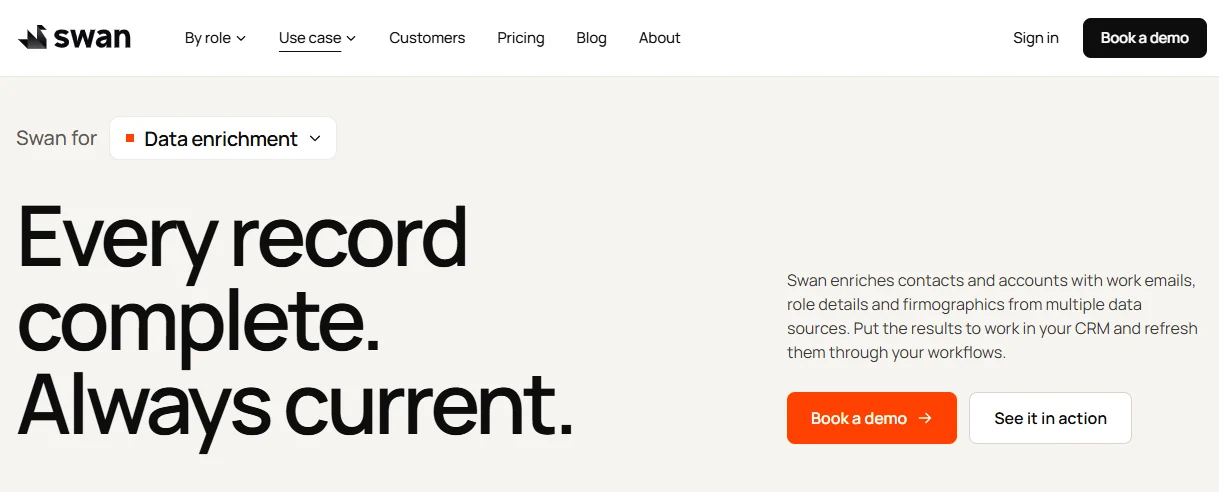
Swan is an AI GTM engineer for B2B SaaS and AI-native revenue teams. It runs on a GTM brain: shared memory of every deal, contact, and conversation across sales, marketing, and CS. Its agents monitor signals, research the account, draft outreach, and log the work in your CRM. ZoomInfo hands you a record. Swan carries it through to a sent sequence.
You build plays in natural language, the way you’d brief a teammate. For example: “When a funded account starts hiring SDRs, find the head of sales, check our CRM history and draft a sequence for approval.” Swan turns that into a live workflow. Changing it takes one more message. Our guide to signal-based outbound walks through more plays.
The payoff shows up in speed. At Finout, the median wait between a form submission and outreach enrolment was seven hours. The team now follows up within five minutes, and pricing-form conversion rose from about 15% to about 35%.
Key Features
- Signal triggers: Starts plays from website visits, LinkedIn engagement, funding and hiring events, Bombora intent, and replies.
- Account research: Works from your ICP, CRM history, and the GTM brain’s memory of each account.
- GTM brain: Gives sales, marketing, and CS one shared memory, so every team works from the same account context.
- Apps: Lets anyone generate apps and dashboards on top of the GTM brain, so each team gets an interface that fits its workflow.
- Plain-English plays: You describe the play, and Swan builds it and keeps it running.
- Email and LinkedIn sequences: Drafts and sends both channels from your connected inboxes.
- Flexible approvals: Sends sequences automatically or posts them to Slack for approval, play by play.
- Enrichment waterfall: Finds work emails and phone numbers across several providers.
- CRM logging: Writes email and LinkedIn activity to the HubSpot timeline.
Pricing
Swan runs on usage-based credits. You pay for the work Swan does, such as research, enrichment, and outreach, and enrichment is charged only when data comes back.
Pros
- Starts outreach from live signals, not from an exported list.
- Researches each account before it drafts, so reps don’t do it by hand.
- Carries the play through to sending, with approval on or off for each play.
- Lets your team build and change plays in plain English, with no tables to maintain.
- Pulls contact data through its own provider waterfall, so you don’t need a ZoomInfo contract to run it.
- Gives marketing and CS the same context as sales, so the value reaches the whole GTM org.
Cons
- Data coverage varies by region and company size.
2. Apollo: Best for teams that want data, sequences, and calls in one login
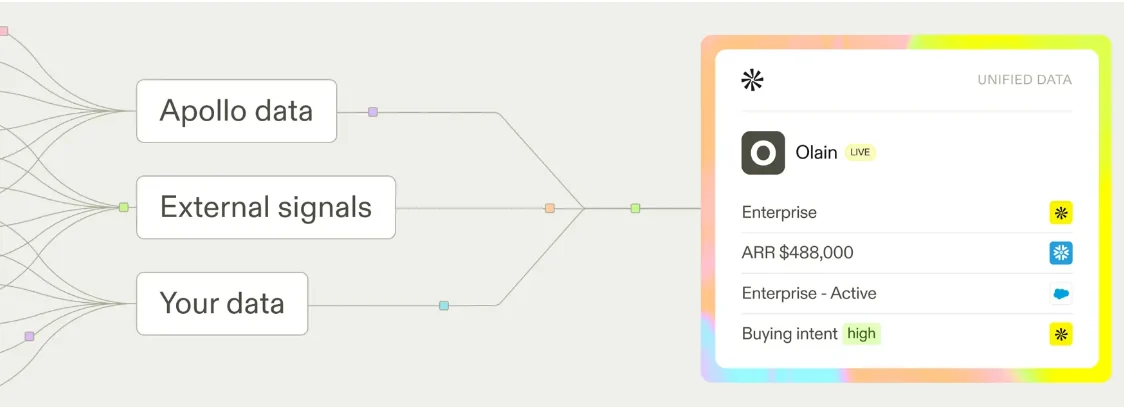
Apollo calls itself an AI GTM system. It pairs a contact database of 240M contacts and 30M companies with sequences, a dialer, and a Chrome extension. It is the closest swap for ZoomInfo’s core job, with a free plan to start.
The work stays with your team, though. A rep still picks the intent topics, builds the list, and decides when to reach out.
Key Features
- Database and enrichment: Searches 240M contacts, with waterfall enrichment and a Chrome extension.
- Sequences and dialer: Runs email sequences and a parallel dialer from the same account.
- Buying intent: Intent signals powered by Bombora, at company level and refreshed weekly.
- AI tools: An AI Assistant, plus MCP connections for tools such as ChatGPT and Perplexity.
- Compliance tools: Do-Not-Call screening, GDPR settings, and unsubscribe controls.
Pricing
- Free: $0, with 900 credits a year.
- Basic: $49 per user a month, billed annually.
- Professional: $79 per user a month, billed annually.
- Organization: $119 per user a month, billed annually.
- Custom: For teams that need custom volumes.
Pros
- Publishes its plan prices, from $0 to $119 per user a month, where ZoomInfo needs a quote.
- Puts data, sequences, a dialer, and a Chrome extension under one login.
- Includes company-level Bombora intent on every plan, and a free plan to test it.
Cons
- Capterra reviewers report outdated contacts and bounces, and one says many phone numbers are generic company lines.
- Credits expire each cycle with no rollover, including add-on credits, so unused credits are lost.
- Intent is company-level only.
3. Cognism: Best for teams that sell into Europe and call prospects
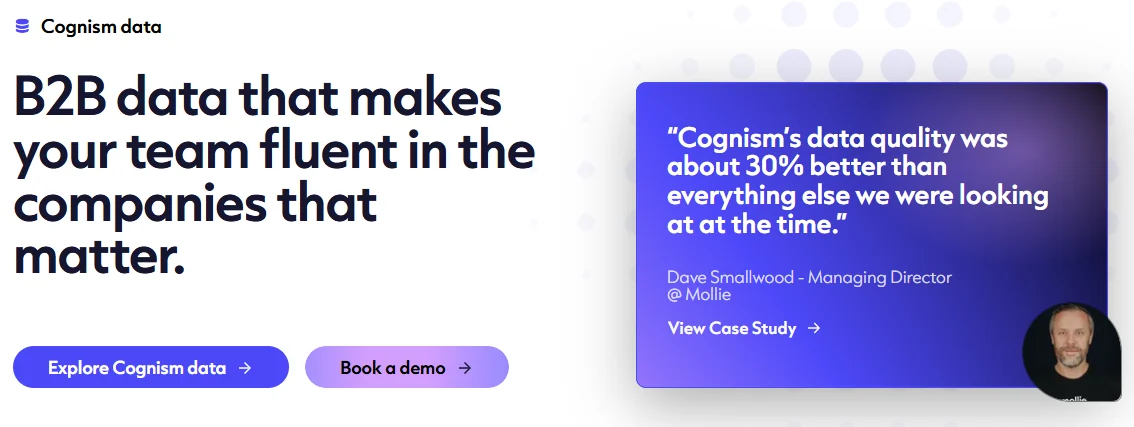
Cognism calls itself Europe’s most trusted B2B data. It focuses on phone-verified mobile numbers and compliance. It doesn’t publish an exact record count, though it says its database holds hundreds of millions of profiles.
It is a data tool, not an outreach tool. Reps pull contacts here, then send and call from somewhere else.
Key Features
- Diamond Data: Phone-verified mobiles, which Cognism says cover more than 10M contacts.
- Signals: Hiring, job-change, and funding alerts, with Bombora intent on Pro.
- Compliance screening: Checks numbers against Do-Not-Call lists and claims GDPR and CCPA compliance.
- Research and enrichment: AI account research and CSV export, with API and MCP access. CRM enrichment is a paid add-on.
- Integrations: Salesforce, HubSpot, Pipedrive, Microsoft Dynamics, Outreach and Salesloft.
Pricing
- Quote only: Cognism publishes no prices.
- Standard and Pro: Each includes five seats. Pro adds Bombora intent on up to 12 topics and on-demand mobile verification.
Pros
- Strong phone data for Europe. Capterra reviewers praise its verified mobiles.
- Screens against Do-Not-Call lists in the UK, US, Australia, and several European countries.
- Refreshes director-level and above contacts every 30 days, per Cognism.
Cons
- Quote-only, so you can’t compare cost before a sales conversation.
- Its site lists no sequencer or dialer, so reps send and call from another tool.
- G2 reviewers tag inaccurate data and incorrect numbers as top dislikes.
4. Lusha: Best for solo reps who prospect from LinkedIn
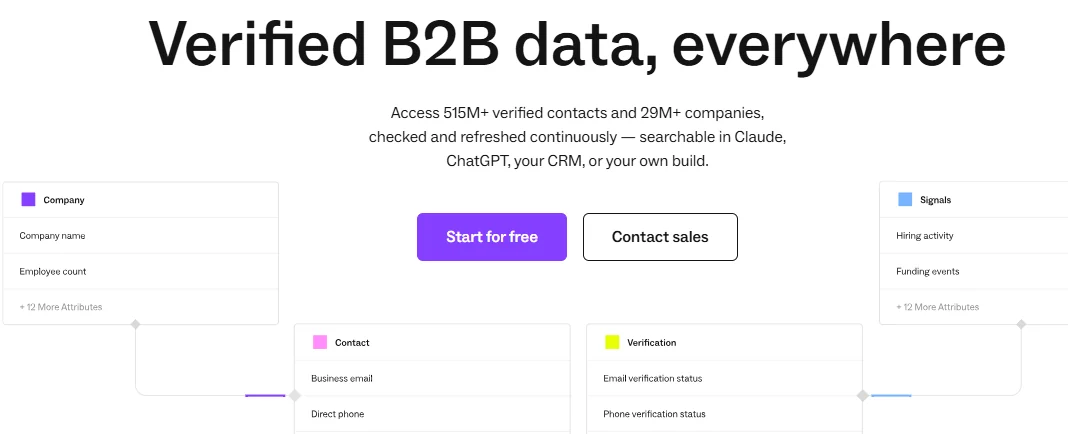
Lusha describes itself as the data and intelligence layer for GTM teams. It claims 515M+ contacts and 29M+ companies. A Chrome extension, simple credits, and a low entry price make it an easy first tool.
It also sends email. Lusha’s Engage feature adds basic sequencing, so small teams can prospect and send from one place.
Key Features
- Chrome extension: Reveals emails and phone numbers while reps browse LinkedIn.
- Signals: 26 signals, which Lusha says refresh weekly, built from public LinkedIn activity and company-level website traffic changes.
- Engage: Native email sequencing, up to 1,000 emails a day, at no extra charge.
- Enrichment: Enriches records through CRM, CSV, API, and waterfall.
- Integrations: Salesforce, HubSpot, Pipedrive, Clay and Zapier, plus Claude, ChatGPT and MCP connectors.
Pricing
- Free: $0 a month, with 40 credits a month and one seat.
- Starter: $37.45 a month, billed yearly, with 4,800 credits a year and one seat.
- Pro: $52.45 a month, billed yearly, with 7,200 credits a year and two seats.
- Premium: $299.95 a month, billed yearly, with 40,800 credits a year and five seats.
- Scale: Custom credits and seats, through sales.
Pros
- Offers a free plan and self-serve paid plans from $37.45 a month, billed yearly, so a rep can start without a sales call.
- Lets reps pull contacts straight from LinkedIn, with CRM integrations for HubSpot and Salesforce.
- Includes email sequencing and 26 buying signals without a separate tool.
Cons
- G2’s top five dislike themes are all about inaccurate or outdated data.
- A phone number costs five credits, while an email costs one.
- Do-Not-Call screening covers only the UK and US.
5. Clay: Best for GTM engineers who want to build custom workflows
Clay is infrastructure to get data, run agentic workflows, and launch plays. It has no database of its own. It buys data from 200+ providers under one contract and runs it through tables. It suits a team with a builder, though someone still designs, runs, and fixes every table.
Key Features
- Waterfall enrichment: Queries many providers in turn and returns the best match, with no charge for failed lookups.
- Claygent: An AI research agent that works from prompts you write.
- Signals: Job changes, promotions, and company news on Launch and above, with web intent on Growth.
- Native sequencer: Sends email from inside Clay and drafts replies in Slack.
- API and MCP access: CLI, API, webhooks and MCP for custom builds.
Pricing
- Free: $0, with 500 Actions and 100 Data Credits a month
- Launch: $185 a month, or $167 a month billed annually
- Growth: $495 a month, or $446 a month billed annually
- Enterprise: Custom
Pros
- Pulls from 200+ providers under one contract, so one weak source doesn’t sink a list.
- Offers a free plan and monthly billing, with no annual commitment required.
- Gives technical teams full control through Claygent, webhooks, API, and MCP.
Cons
- Has a steep learning curve.
- Runs on two meters: Actions and Data Credits. Under its March 2026 pricing model, HTTP API calls also consume Actions.
- Locks CRM sync and web intent signals behind the $495-a-month Growth plan, and quality depends on the providers you wire in.
Selection Criteria: How We Evaluated
Most ZoomInfo comparisons rank on database size. We ranked on what happens after the pull. Each tool faced five questions:
- Cost clarity: Is pricing published, and what happens to unused credits and at renewal?
- Data fit: How strong is the data for the regions and roles you sell to?
- Trigger: Does outreach start from a signal, or from an exported list?
- Action: Who researches the account and sends the message, the rep or the tool?
- Upkeep: Who builds and maintains the workflow once it’s live?
We checked each vendor’s own pricing pages, docs, and site in October 2026. Then we read G2 and Capterra reviews to see what teams push back on.
How to Choose the Best ZoomInfo Alternative
Start with the reason you’re leaving ZoomInfo. Then match it to the tool that fixes that problem.
- You pay for data and your reps still research by hand: Choose Swan. It researches each account and enriches contacts before drafting, using contact data enrichment.
- You want pipeline per rep without more SDRs: Pick Swan. Plays run on signals, and reps step in only where you want approval, as our sales team page explains.
- Your sales, marketing, and CS teams work in silos: Go with Swan. Its GTM brain gives every team the same memory of each account.
- You want one login for data, sequences, and calls: Go for Apollo.
- You sell into Europe and phone your prospects: Choose Cognism.
- You are a solo rep who prospects from LinkedIn: Try Lusha.
- You have a GTM engineer who likes to build: Pick Clay.
Whichever you choose, test it on the segment your reps work hardest. That shows fastest whether the tool saves hours or just moves them. For a wider view, see our guide to the best sales automation tools.
Stop Renting Data, Start Running Plays
ZoomInfo gives you a deep database on a custom contract. It leaves two costs on your side: records you have to verify, and the manual work between a signal and a sent message. A cheaper data tool can trim the first. Only a tool that does the work removes the second.
Swan takes on that second cost. When a signal lands, Swan researches the account, drafts the sequence, and sends it or routes it to Slack for approval. Sales, marketing, and CS all work from the same GTM brain. Your team focuses on strategy. Swan runs the pipeline.
Pick one signal your team already watches and hand it to Swan. Keep your current data source running while you compare, then decide at renewal with proof in hand.
FAQs
What Is the Best Alternative to ZoomInfo?
It depends on what you’re leaving. Swan is the best ZoomInfo alternative for teams that want outreach triggered by signals and researched automatically. Apollo and Lusha suit teams that mainly want cheaper data. Cognism suits teams that sell into Europe.
Is There a Free Alternative to ZoomInfo?
Yes. Apollo, Lusha, and Clay all have free plans with limited credits. Lusha gives 40 credits a month. Clay gives 500 Actions and 100 Data Credits a month. Swan offers a 14-day free trial with no payment method required.
How Much Does ZoomInfo Cost Compared With Its Alternatives?
ZoomInfo publishes no prices. Cognism is also quote-only. Lusha’s paid plans start at $37.45/month (billed yearly), and Clay’s start at $185/month, or $167 billed annually. Apollo’s paid plans run from $49 to $119 per user per month, billed annually. Swan runs on usage-based credits.
Which ZoomInfo Alternative Is Best for European Data?
Cognism is the strongest pick for Europe. It focuses on phone-verified mobiles, screens against Do-Not-Call lists in several European markets, and claims GDPR compliance.
Do I Need ZoomInfo to Use Swan?
No. Swan runs its own mix of data providers for enrichment, so a ZoomInfo contract isn’t a prerequisite. You can run Swan next to your current data source while you compare, then decide at renewal.
How Is Swan Different From an AI SDR?
Many AI SDRs focus on outbound and a single channel. Swan covers inbound and outbound across the funnel, and its GTM brain gives marketing and CS the same context as sales. It starts with a signal, researches each account, and sends sequences automatically or holds them for approval.