
Playbooks· 16 min read
5 Best Apollo Alternatives in 2026 for Signal-Led Outbound
Apollo’s lists and sequences not enough? Compare 5 Apollo alternatives, from Swan, which finds buying signals and does account research, to data tools.
 Amos Bar-JosephCo-Founder & CEO ·
Quick Summary
Apollo is amongst the easiest ways to start outbound. You get a large contact database, sequences, and a dialer in one place. The trouble starts when your team grows. Lists go stale, sequences fire on a timer, and reps still research every account by hand.
The right Apollo alternative depends on what you’ve outgrown. If you only need better data, a data provider fixes that. If you need to know who to contact, when and why, you need a tool that starts from signals and does the research for you.
We compared five Apollo alternatives on what triggers outreach, who does the research, how they send, and what they cost.
Top 3 Apollo Alternatives at a Glance
| Tool | Best for | Starting price |
|---|---|---|
| Swan | Teams that want signals and research built into every play | Usage-based credits, free trial |
| Clay | GTM engineers who want to build custom data workflows | Free; paid from $185/mo |
| Amplemarket | Teams that want one all-in-one tool with an AI copilot | $600/mo, billed annually |
When a Bigger Database Stops Adding Pipeline
Apollo follows a simple flow. You pull a list, load it into a sequence, and let the steps run. This works when your market is wide, and your team is small. Sending a lot of emails makes up for bad timing.
As you grow, the problems show up. Your reps pull from the same database as your competitors’ reps. The first email goes out because a sequence step is due, not because something changed at the account. Before each send, someone still has to look up the company, check the CRM, and find a reason to reach out.
A bigger list won’t fix this. So we first tested each alternative on one question: does it tell you when to reach out and why, or does it just give you more names?
Why Listen To Us?
Swan is an AI GTM engineer. We watch for buying signals, research each account, and draft outreach your team approves. Over 300 GTM organizations run that work through us.
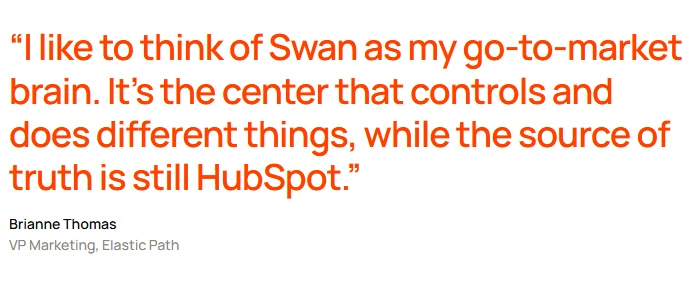
Before Swan, one outbound email at Elastic Path took 14 manual steps across seven tools and more than 30 minutes of prep. Now 90% of its outbound runs through Swan. At Utila, GTM engineer Din Arbel credits Swan with $1.8M in pipeline in four months.
Many of our customers still keep Apollo in their stack. So we’ve seen exactly where a database stops and where signal-led work has to take over.
What Is Apollo?
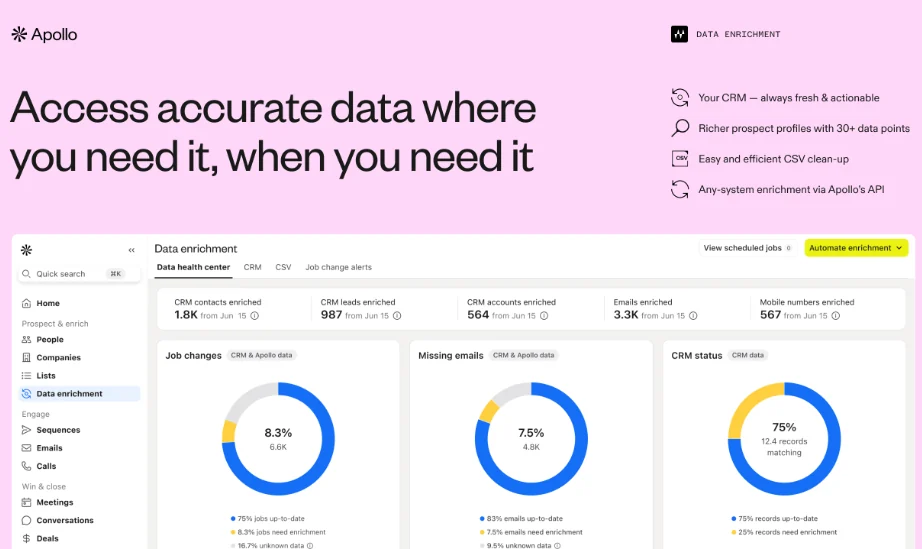
Apollo is a B2B sales platform that combines a contact database, sequencing, and a dialer. Its database lists 240M+ contacts and 30M+ companies, and over 600,000 companies use it. A rep can filter for the right titles, reveal emails and phone numbers, and add contacts straight to a sequence.
Around that core, Apollo has added waterfall enrichment, a Chrome extension, deliverability tools, a parallel dialer, and AI agents trained on your playbooks. It also shows buying intent and website visitors.
For a small team starting outbound, that’s a lot of value in one login. Apollo holds a 4.7 out of 5 rating on G2 from nearly 10,000 reviews. The question is what happens once list volume stops turning into meetings.
Why Do Teams Look for Apollo Alternatives?
On G2, “Inaccurate Data” and “Data Inaccuracy” together appear in close to 900 reviewer cons. Data is only part of the story, though. Most teams that leave Apollo hit four problems.
1. Static Lists Go Stale
A database is a snapshot. People change jobs, companies restructure, and emails stop working between the day you verify a record and the day you send. Apollo puts its verified email accuracy at 91%. That’s strong for a database this size. However, that still means about 1 in 11 verified emails can bounce.
Apollo refunds the credit if a verified email bounces within 30 days. Your sending domain, however, still takes the hit.
2. Intent Stops at the Company
Apollo’s buying intent comes from Bombora. Scores are measured at the company level and refreshed weekly. Apollo itself notes that the people you find at a high-intent company may not be the ones doing the research.
So you learn that an account is warming up. You don’t learn who is driving it, what they care about, or what to say.
3. Research Still Falls on the Rep
A sequence sends on a schedule. It doesn’t know a prospect’s company just raised a round or that their champion moved to a new account last week. To write anything relevant, a rep has to leave Apollo, open the CRM, read the news, and check LinkedIn.
That prep time grows with every rep and every account. It’s also the work most teams hoped software would take off their plate.
4. Credits Expire Every Cycle
On Apollo’s pricing page, credits pool across the team and reset at the start of each billing cycle. Whatever is left expires at the end of the cycle, including any add-on credits you bought. Every seat must be on the same plan, so upgrading one power user means upgrading everyone.
The 5 Best Apollo Alternatives Compared
We ranked each tool by how far it moves you past list-and-sequence outbound.
| Tool | What starts outreach | Who does the research | Built-in sequencing | Pricing model |
|---|---|---|---|---|
| Swan | Live signals, inbound and outbound | Swan, before every draft | Email + LinkedIn | Usage-based credits, free trial |
| Clay | Signals or lists you build into tables | Claygent, from prompts you write | Email (native sequencer) | Actions + Data Credits |
| Amplemarket | Signals tracked by its Duo copilot | Duo, for tracked accounts | Email, phone, social, voice | Annual contract, per user |
| ZoomInfo | Intent and signals on higher tiers | Copilot, for your reps | Via sales engagement tools | Custom quote |
| Cognism | Lists filtered by signals | Your team, with AI account research | No (exports to your sequencer) | Custom quote, per seat |
1. Swan: Best for teams that want signals and research built into every play
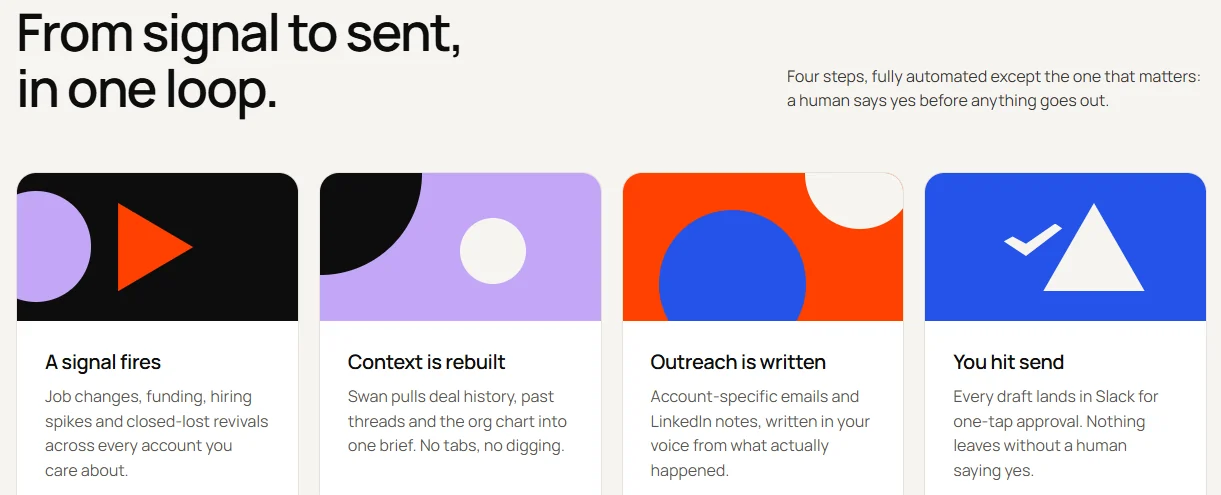
Swan is an AI GTM engineer for B2B SaaS and AI-native revenue teams. Apollo hands you contacts to load into a sequence. Swan starts from a reason to reach out, does the research, and drafts the message for your approval.
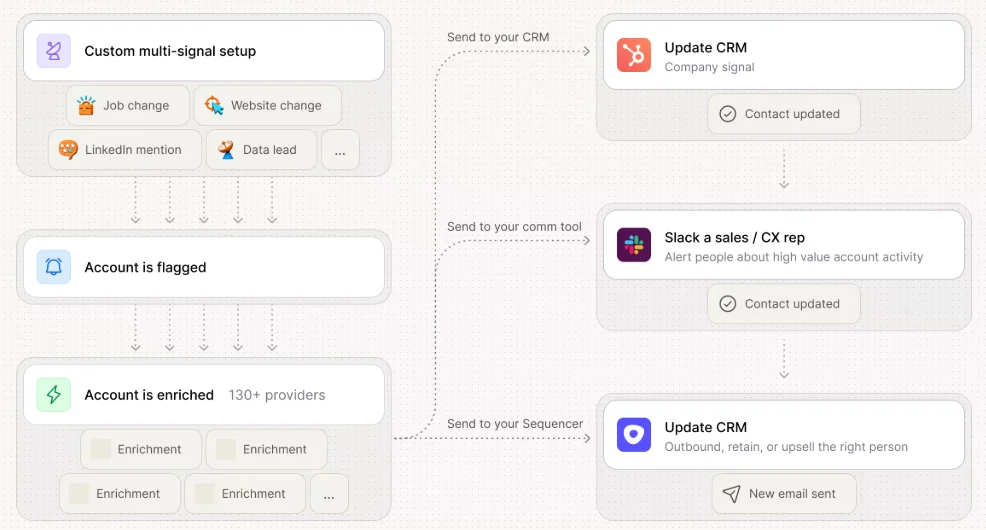
Every play begins with a signal. That could be a champion changing jobs, a funding round, or a hiring surge. It could also be a closed-lost deal waking up or a target account on your pricing page. Swan then pulls deal history, past threads, tech stack, and org chart into one brief. It writes email and LinkedIn steps in your team’s voice, learning from your best past messages. That’s how signal-based outbound flips the usual order: the reason comes first, and the email second.
Swan connects to Apollo as a data source, so you can keep it for enrichment and let Swan decide who to contact and when. At Finout, Swan cut lead-to-speed from a 7-hour median to about 5 minutes and now influences more than half of the pipeline.
Key Features
- Signal monitoring: Tracks job changes, funding, hiring surges, tech-stack changes, LinkedIn engagement, Bombora intent, and website visits.
- Built-in visitor identification: Identifies website visitors at the person level, with no separate pixel tool to buy.
- Account research: Builds a brief on each account from your CRM, inbox, call notes, news, and data providers before anything is written.
- Native sequencing: Sends email and LinkedIn steps from your own connected inboxes and LinkedIn accounts.
- Reply handling: Sorts every reply, finds a new address after a bounce, reschedules after out-of-office replies, and drafts answers to positive ones.
- Slack approvals: Lets reps approve, edit, or deny each contact’s sequence from Slack or the Swan app.
- Waterfall enrichment: Queries providers in order of accuracy for each field and charges only when data comes back. See how contact data enrichment works in Swan.
Pricing
Swan uses usage-based credits that your whole team shares. You pay for the GTM work Swan does, like research, enrichment, outreach, and CRM updates. Seats go only to people who chat with Swan or approve its work, and viewers are free.
Unused credits roll over, and annual billing saves up to 20%.
Pros
- Outreach starts from a live signal, not a list pulled weeks ago.
- Research happens before a rep sees the draft, so no one preps accounts by hand.
- Works alongside Apollo, so you can switch in stages instead of all at once.
- Covers inbound too, with person-level visitor identification and automated lead qualification.
- Seats go only to people who work with Swan, so dashboard viewers cost nothing.
Cons
- There’s no bulk approval, so high-volume plays need someone to clear the review queue each day.
2. Clay: Best for GTM engineers who want to build custom data workflows
Clay describes itself as infrastructure to get any data, run agentic workflows, and launch GTM plays. Teams often run it next to Apollo to fill the gaps a single database leaves. Each workflow lives in a table, with rows as accounts or people and columns as steps.
Clay suits technical teams that want full control over enrichment and scoring. It moves you from one database to many. But someone on your team still designs, runs, and maintains every table.
Key Features
- Data marketplace: Buys data from 200+ data and AI vendors under one Clay contract.
- Claygent: Researches target companies and people with AI, using prompts you write.
- Signals and intent: Tracks job changes, promotions, and company news, with web intent on Growth and above.
- Native sequencer: Sends messaging from inside Clay, or pushes contacts to your own tools.
- Ad audiences: Syncs target lists to LinkedIn, Meta, and Google Ads.
Pricing
- Free: $0.
- Launch: From $185/month, or $167/month billed annually.
- Growth: From $495/month, or $446/month billed annually.
- Enterprise: Custom price on an annual contract.
Pros
- Pulls data from 200+ providers, so one weak source doesn’t sink a list.
- Includes unlimited users on every plan.
- Gives technical teams near-total control over how each workflow runs.
Cons
- Your team has to build and maintain every play.
- CRM auto-sync and web intent signals start on the Growth plan.
- Two separate meters, Actions and Data Credits, make monthly spend harder to forecast.
3. Amplemarket: Best for teams that want one all-in-one tool with an AI copilot
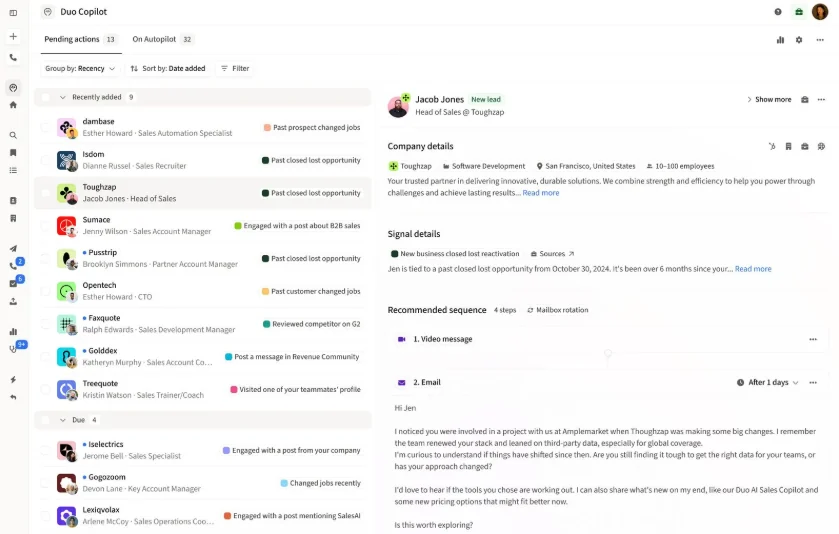
Amplemarket is an all-in-one AI sales platform built around Duo, its AI sales agent. It’s the closest match to Apollo’s single-login setup, but with signals and AI research layered on. If you like having data and sequences in one place, it’s the smallest leap.
Duo builds a model of your ideal customers from your website, CRM, and the open web. It watches for signals like job changes, promotions, competitor evaluations, and website visits. Then it drafts multichannel outreach for the accounts you track.
Key Features
- Duo copilot: Drafts sequences and replies, and follows up when no meeting gets booked.
- AI intent signals: Flags job changes, post engagement, competitor research, and closed-lost prospects ready to revisit.
- Multichannel sequences: Mixes email, calls, social steps, and personalized voice notes.
- Deliverability tools: Includes a domain health center, spam checker, and smart warmup.
- Job change alerts: Tracks 500 to 2,000 contacts, depending on the plan.
Pricing
- Startup: $600 a month on an annual contract, with 2 users
- Growth: Custom, with 4 users
- Elite: Custom, with 10 users
Every plan includes a free trial.
Pros
- Combines data, signals, sequences, and deliverability under one login.
- Duo researches tracked accounts and drafts outreach, so reps start with context.
- Supports voice notes and calls alongside email and social steps.
Cons
- The entry plan requires an annual commitment of $600/month.
- Startup includes only 600 phone credits per user per year.
- Duo Voice and a dedicated CSM start on the custom-priced Growth plan.
4. ZoomInfo: Best for larger teams that need deep data and intent
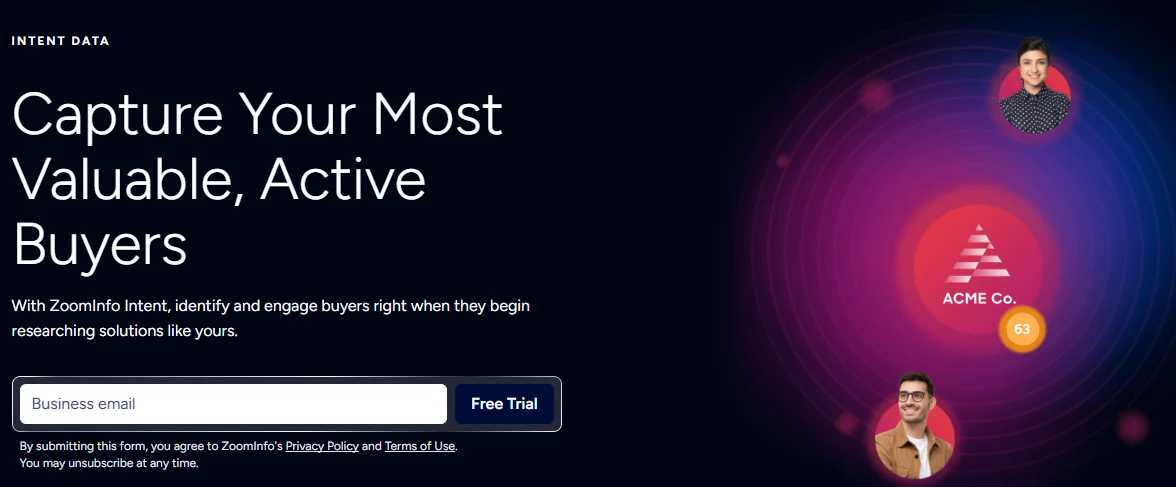
ZoomInfo calls itself an AI GTM platform. It sits on a database of 500M+ contacts and 100M+ companies, about double Apollo’s contact count. If your main problem with Apollo is coverage, ZoomInfo is the bigger, more enterprise-grade upgrade.
Its newer layers aim at the same gap Apollo leaves. Copilot acts as an AI sales agent for reps. GTM Studio runs workflows triggered by buying signals, and the GTM Context Graph explains why an account is moving.
Key Features
- Contact and company data: Covers 500M+ contacts with mobile numbers and business emails.
- Buyer intent: Surfaces intent signals and clusters on Copilot Advanced, with real-time intent on Enterprise.
- Champion tracking: Alerts reps when past buyers change jobs.
- GTM Studio: Builds and runs workflows when funding, hiring, or other signals fire.
- Integrations: Connects natively with Salesforce, HubSpot and Dynamics 365, plus 120+ other tools.
Pricing
ZoomInfo doesn’t publish prices. Quotes depend on features, license count, and credit usage.
- Professional: Contact data, search, export, and CRM integrations
- Copilot Advanced: Adds intent, website visitors, champion tracking and workflows
- Copilot Enterprise: Adds real-time intent, custom signals and Copilot chat
All three sales plans offer a free trial.
Pros
- Offers one of the largest B2B contact databases on the market.
- Pairs data with signals and AI research inside one platform.
- Fits enterprise stacks with native CRM integrations and 120+ connectors.
Cons
- Pricing is quote-only, so costs aren’t clear until you talk to sales.
- Intent, website visitors, and job-change signals need Copilot Advanced or higher.
- “Outdated Data” and “Outdated Contacts” are among the top cons on G2.
5. Cognism: Best for teams selling into Europe
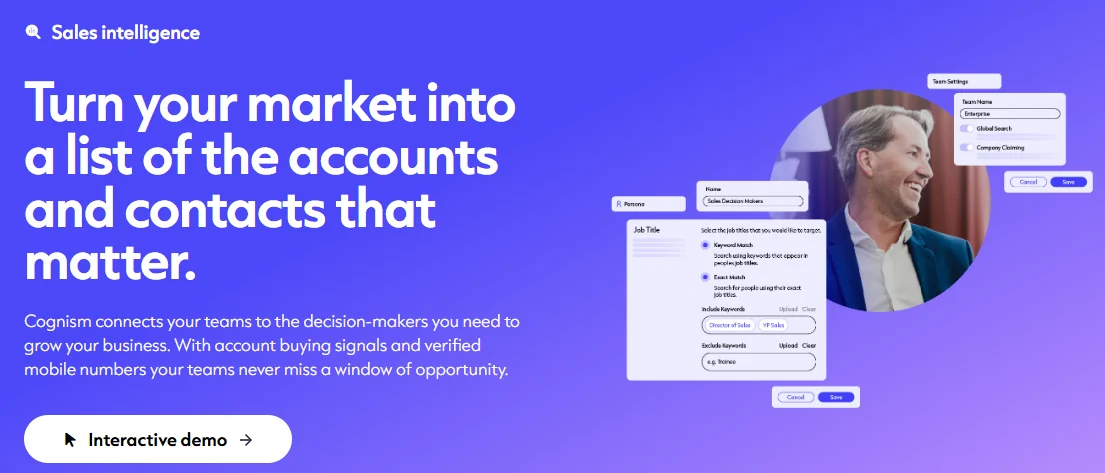
Cognism is a sales intelligence platform known for compliant European data. It’s the pick when Apollo’s coverage outside the US falls short, or when phone is your main channel. Its phone-verified mobiles go through extra accuracy checks, and Cognism claims up to 3x higher connect rates.
Outreach still starts from a list, which you can filter by hiring, funding, and job-change signals. You then work those contacts in the CRM or sequencer you already use.
Key Features
- Phone-verified mobiles: Adds extra verification layers to mobile numbers on the Pro plan.
- Compliance: Screens against Do-Not-Call lists across Europe and complies with GDPR and CCPA.
- Data refresh: Refreshes Director-level and above records every 30 days.
- Intent data: Lets admins pick up to 12 Bombora intent topics on Pro.
- MCP and API access: Brings Cognism data into AI tools and your own systems.
Pricing
Cognism doesn’t publish prices. Both plans are quoted and include 5 seats.
Standard: Core data, signal-based list filters, AI account research, and MCP and API access
Pro: Adds higher-quality mobile data, on-demand mobile verification, and intent
Pros
- Leads the field on compliant European contact data.
- Phone-verified mobiles help teams that book meetings by phone.
- Re-viewing revealed contacts cost nothing.
Cons
- Has no built-in sequencing, so outreach needs a separate tool.
- Intent data and on-demand mobile verification require the Pro plan.
- Quotes come only through a sales conversation.
Selection Criteria: How We Evaluated
Most Apollo comparisons ask which tool has the bigger database. We asked what happens after you find a contact. Each tool was judged on five questions:
- Trigger: Does outreach start from a live signal, or from a list someone exported?
- Research: Who builds the account context before the first message, the rep or the tool?
- Execution: Can the tool send the outreach, or does it hand contacts to another sequencer?
- Data fit: How strong is the contact data for the regions and roles you sell to?
- Cost clarity: Is pricing published, and what happens to credits you don’t use?
We checked each vendor’s pricing page and product docs in October 2026. Then we read G2 and Capterra reviews to see what real teams praise and push back on.
How to Choose the Best Apollo Alternative
Name what you’ve outgrown first. Then match it to the tool built for that gap.
- Your reps spend more time researching than selling: Choose Swan. It researches every account before drafting, so reps review and send instead of digging.
- You want outreach tied to real buying moments: Pick Swan. Every play starts from a signal, and the full set of AI GTM engineer workflows runs inbound and outbound together.
- You have a GTM engineer who loves building: Go for Clay. It gives you 200+ data providers and full control over each table.
- You want Apollo’s all-in-one feel, with AI on top: Try Amplemarket. Data, signals, and sequences stay under one login.
- You need more data depth for enterprise accounts: Select ZoomInfo. It brings 500M+ contacts and tiered intent.
- You sell mostly into Europe or by phone: Use Cognism. It leads on compliant EU data and verified mobiles.
Before you sign anything, run a two-week test on one live signal, such as job changes at your top accounts. Track how many meetings each tool books, not how many contacts it exports.
Stop Pulling Lists, Start Acting on Signals
Apollo got your outbound off the ground. A shared database and a timed sequence are a fine place to start. But they can’t tell you who is ready now, and they leave the research to your reps.
That’s the gap Swan closes. When a signal lands, Swan researches the account, drafts the email and LinkedIn steps, and sends them to Slack for approval. Keep Apollo for data while you test. Your team focuses on strategy. Swan runs the pipeline.
Pick one signal that matters to your team, hand it to Swan, and watch the first researched drafts arrive.
FAQs
What Is the Best Alternative to Apollo?
It depends on what you’ve outgrown. Swan is the best Apollo alternative for teams that want outreach triggered by signals and researched automatically. ZoomInfo and Cognism suit teams that mainly need deeper or more compliant contact data.
Is There a Free Alternative to Apollo?
Clay has a free plan with 500 Actions and 100 Data Credits a month. Swan offers a 14-day free trial with no payment method required. Amplemarket and ZoomInfo also offer free trials on their paid plans.
Is ZoomInfo Better Than Apollo?
ZoomInfo has the larger database, with 500M+ contacts against Apollo’s 240M+. It also offers deeper intent on its Copilot tiers. Apollo is cheaper and easier to start with because it publishes prices and offers a free plan.
Which Apollo Alternative Is Best for European Data?
Cognism is the strongest pick for Europe. It screens Do-Not-Call lists across Europe, complies with GDPR, and refreshes senior contacts every 30 days.
Can I Keep Apollo and Add Swan on Top?
Yes. Swan connects to Apollo as a data source, so you can keep your Apollo data while Swan handles signals, research, and outreach. Many teams start this way, then decide later whether to keep both.
How Is Swan Different From an AI SDR?
Most AI SDRs send volume from a list with little oversight. Some founders have watched their domain reputation tank. Swan starts with a signal, researches each account, and holds every sequence for a person’s approval before sending.