
Playbooks· 15 min read
10 Best AI Tools for Lead Qualification
We review the best AI tools for lead qualification, from full-stack GTM platforms to signal-based tools; spend less time sorting leads and more closing deals.
 Amos Bar-JosephCo-Founder & CEO ·
Quick Summary
The best AI lead qualification tools score, research, and route prospects automatically, so your reps talk to the right people first instead of leads that won’t convert. Swan stands out for closing the gap between lead qualification and outreach. Clay and Apollo follow closely with strong enrichment and prospecting capabilities.
| Tool | Best For | Starting Price |
|---|---|---|
| Swan | Automated signal research and execution for scaling B2B SaaS teams | Custom (platform fee + usage credits) |
| Clay | Building own enrichment and scoring logic | $185/month (free plan available) |
| Apollo | Unified outbound prospecting, enrichment, and outreach | $49/user/month (free plan available) |
Your Sales Team is Qualifying Leads That Will Never Buy
According to HubSpot’s 2026 State of Marketing data, marketers rank lead-to-customer conversion (34%) as a higher priority than lead generation volume (29%). That focus on conversion highlights the importance of the marketing-to-sales handoff, where only 13% of leads make it from marketing-qualified to sales-qualified on average.
That’s a lot of wasted effort. Manually sorting every inbound lead burns hours your team could spend closing deals. AI tools automate the process by scoring, researching, and routing leads, so reps can focus on the leads truly worth pursuing.
This list covers 10 top AI tools for lead qualification, from full GTM platforms to specialised intent and scoring tools.
Why Listen to Us?
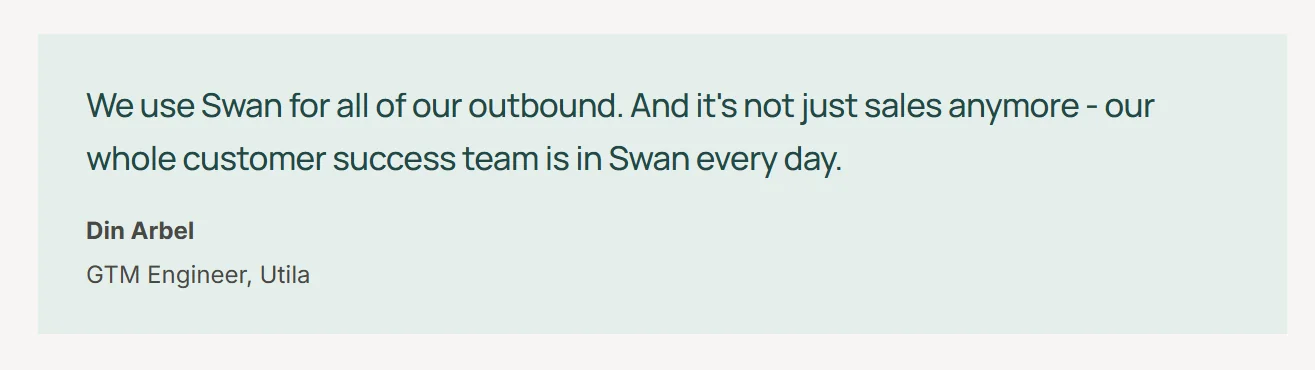
We built Swan to solve this exact problem. Our platform has helped 200+ B2B companies turn raw signals into qualified conversations, including Machinery Partners, Utila, Elastic Path, and SalesDesk.
After implementing Swan, Utila saw a 3× increase in outbound opportunity conversion and attributed $1.8 million in pipeline to the platform within four months.
We work with B2B SaaS teams on sales automation and demand generation, tackling the same challenges this list aims to solve.
What is AI Lead Qualification?
Lead qualification is the process of figuring out which leads are worth your sales team’s time. Not everyone who downloads an ebook or visits your pricing page is ready to buy. You can’t tell who’s serious just by looking at a list, so you need a way to separate buyers from browsers.
AI lead qualification uses automation and machine learning to do that sorting for you. It looks at signals like website behaviour, company size, engagement history, and buying intent to score and prioritise leads. More advanced tools go beyond scoring to research accounts, enrich contact data, and route qualified prospects to the right rep.
Why AI Lead Qualification Matters
Your reps respond faster, and speed matters. Harvard Business Review found that contacting leads within one hour makes you almost 7× as likely to qualify them. AI tools score and route leads in seconds, so your team can reach out while prospects are still engaged.
Your qualification gets more consistent. Manual qualification depends on a rep’s gut feeling and what data they can access at the time. AI can analyse dozens of signals at once and apply the same scoring criteria to every lead.
You can scale without adding headcount. A five-person sales team can’t manually research every inbound lead. AI handles that volume, so reps aren’t stuck researching accounts that won’t close.
The 10 Best AI Tools for Lead Qualification
| Tool | Best For | Starting Price |
|---|---|---|
| Swan | Automated signal research and execution for B2B SaaS teams | Custom (platform fee + usage credits) |
| Clay | Building own enrichment and scoring logic | $185/month (free plan available) |
| Apollo | Unified outbound prospecting, enrichment, and outreach | $49/user/month (free plan available) |
| HubSpot (Sales Hub) | Teams using HubSpot CRM and want lead scoring capabilities | $20/seat/month |
| Warmly | Telling high-intent visitors from strong website traffic | $10,000/year |
| Qualified (Piper) | AI-led visitor engagement for Salesforce-native enterprise teams | Custom (not published) |
| 6sense | Mid-market/enterprise teams running a dedicated ABM motion | Custom (not published) |
| 11x (Alice) | Running outbound at scale for teams with a well-defined ICP | $3,750/month |
| Instantly | High-volume cold email outbound for lean teams | $47/month |
| RB2B | Fast, simple person-level website visitor identification | $79/month (Free plan available) |
1. Swan
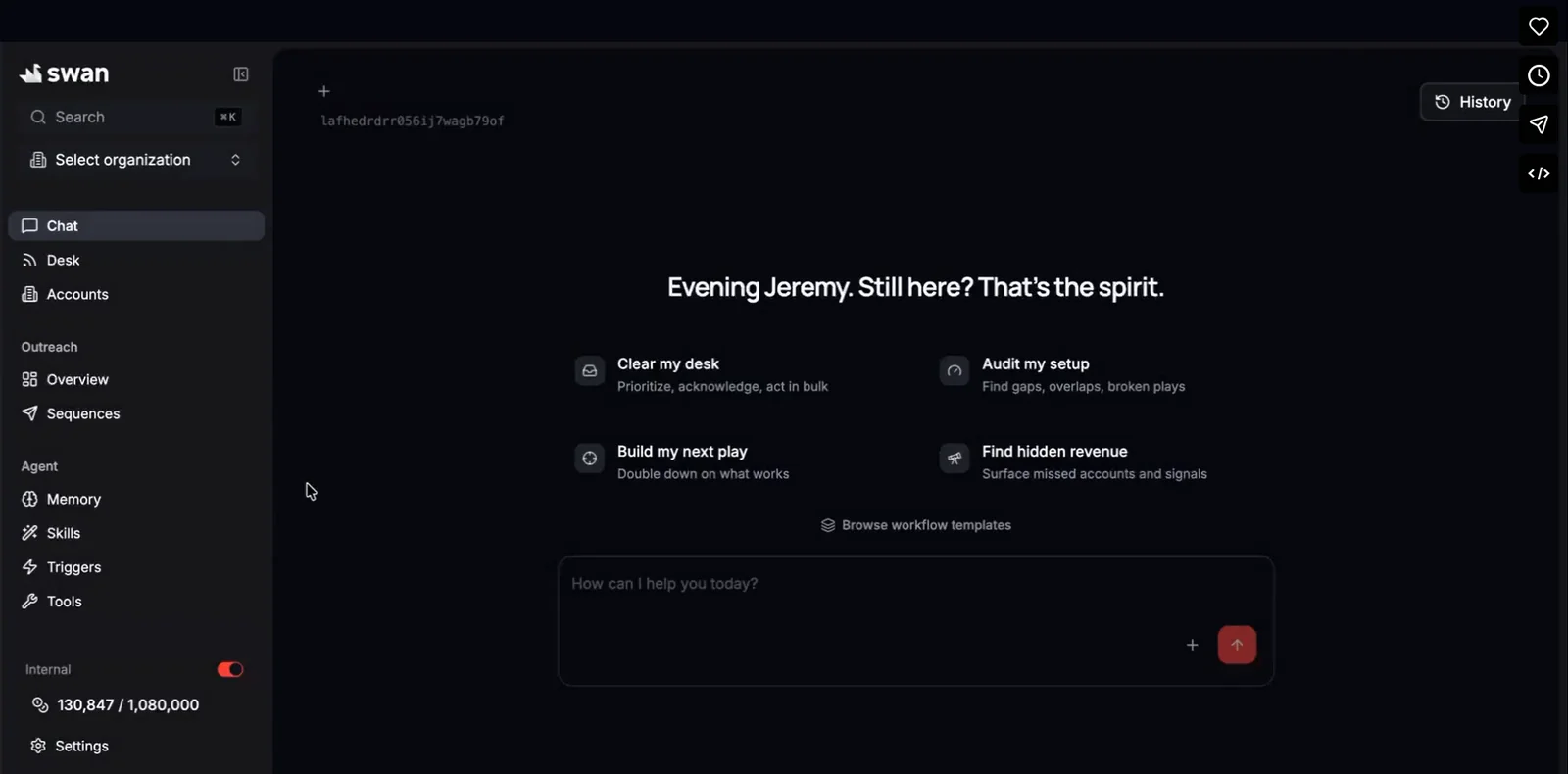
Swan is the AI GTM engineer for B2B SaaS and AI-native revenue teams. Most lead qualification tools stop at scoring: they identify promising accounts, but reps still have to research them, write outreach, and send it. Swan closes that gap between “this lead looks good” and “we’ve reached out.”
When a lead visits your site or closes a funding round, Swan picks up the signal, researches the company, drafts a personalized sequence, and runs it without a human having to notice, decide, or click. You can go from signal to running sequence in under five minutes.
Swan is built for growth-stage B2B revenue teams that want to automate outreach based on buying signals. The platform reports a 22% email-to-meeting rate and a 78% pipeline increase through website visitor identification.
Key Features
- Automated Execution: Where other tools hand you data or a Slack alert, Swan researches, decides, and executes the outreach itself
- Real-time Signal-to-sequence: A website visit, LinkedIn view, or reply triggers research and a running sequence without manual handoff
- Compounding Context: Swan connects HubSpot, Slack, LinkedIn, and your sequencer, bringing signals from across your GTM stack into one picture
- Built-in Natural Language: Describe a GTM play in plain English, and Swan builds the workflow without an engineering ticket or Zapier diagram
- Automated GTM Work: Handles enrichment, signal monitoring, CRM updates, and lead research across your GTM stack, reducing manual work
- Multi-Provider Waterfall: Draw enrichment from RB2B, Apollo, ZoomInfo, and 6sense through one workflow
Pricing
Swan doesn’t publish exact pricing. Plans include a platform fee plus usage-based credits. Annual plans get 20% off, with lower per-credit rates for larger commitments.
Pros
- Institutional memory; context stays with the account even when reps leave
- Covers both inbound and outbound workflows, unlike single-channel AI SDR tools
- Startup-friendly pricing and hands-on onboarding
- Enriches data from multiple providers in one workflow
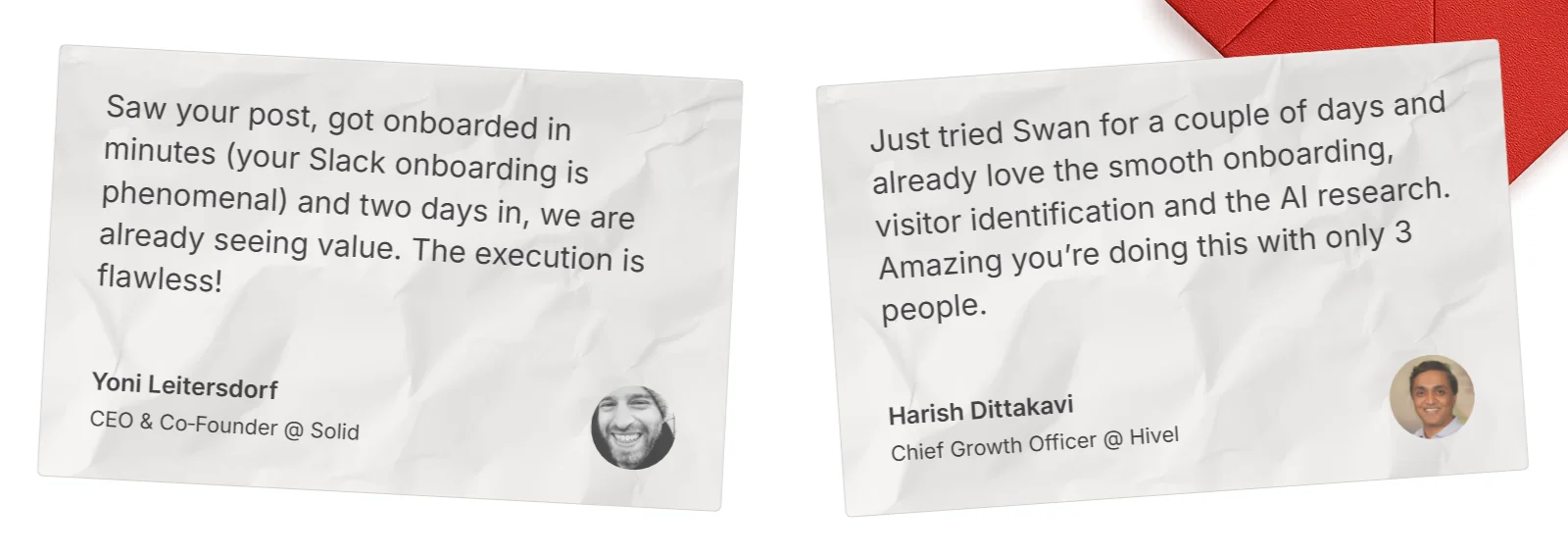
- Fast time-to-value, according to customer feedback
Cons
- Not positioned for consumer apps or businesses
- A newer, smaller vendor compared to established competitors
2. Clay
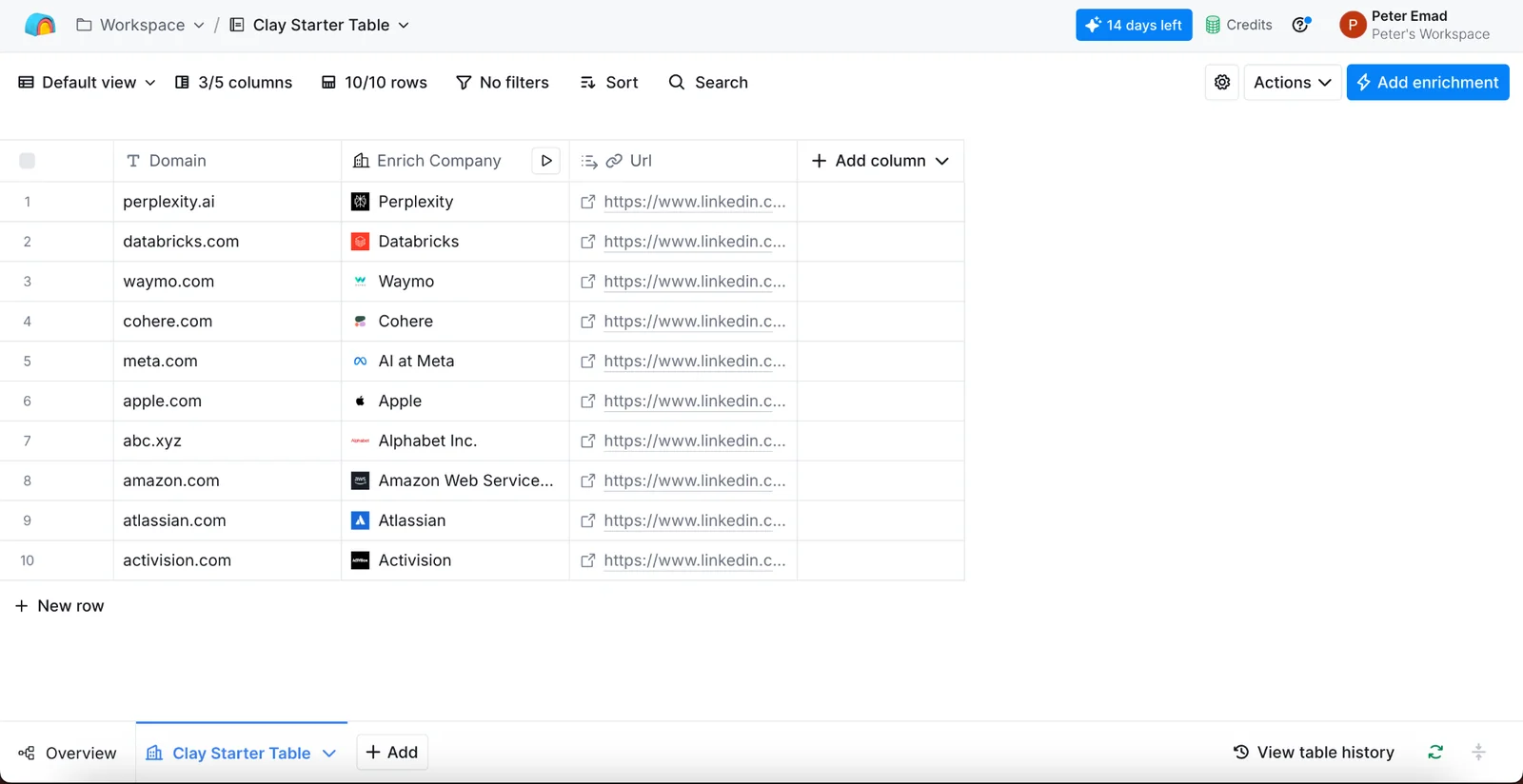
Clay is a data enrichment and workflow platform that pulls from 150+ providers, letting teams build “waterfall” enrichment logic and AI-scored qualification criteria in a spreadsheet-style interface. It’s a strong fit for technically comfortable teams who want to build and own their qualification logic rather than buy it pre-built.
Key Features
- Waterfall enrichment across 150+ data providers to backfill missing emails, phone numbers, and firmographics
- AI research agent, Claygent, that can pull custom, per-row information beyond structured data fields
- Custom AI-scoring formulas built on whatever signals matter to your qualification criteria
- Native Clay Sequencer for running outreach without leaving the platform
Pricing
Clay offers different pricing tiers: Launch starts at $185/month and Growth at $495/month; both are discounted when billed annually. There’s also a free plan and a custom Enterprise plan.
Pros
- Deep multi-source enrichment and automation
- Easy to use once past initial setup
Cons
- Credit consumption can add up quickly on AI-heavy workflows
- Steep learning curve for teams building complex workflows
G2 rating
4.6/5 (234 reviews)
3. Apollo
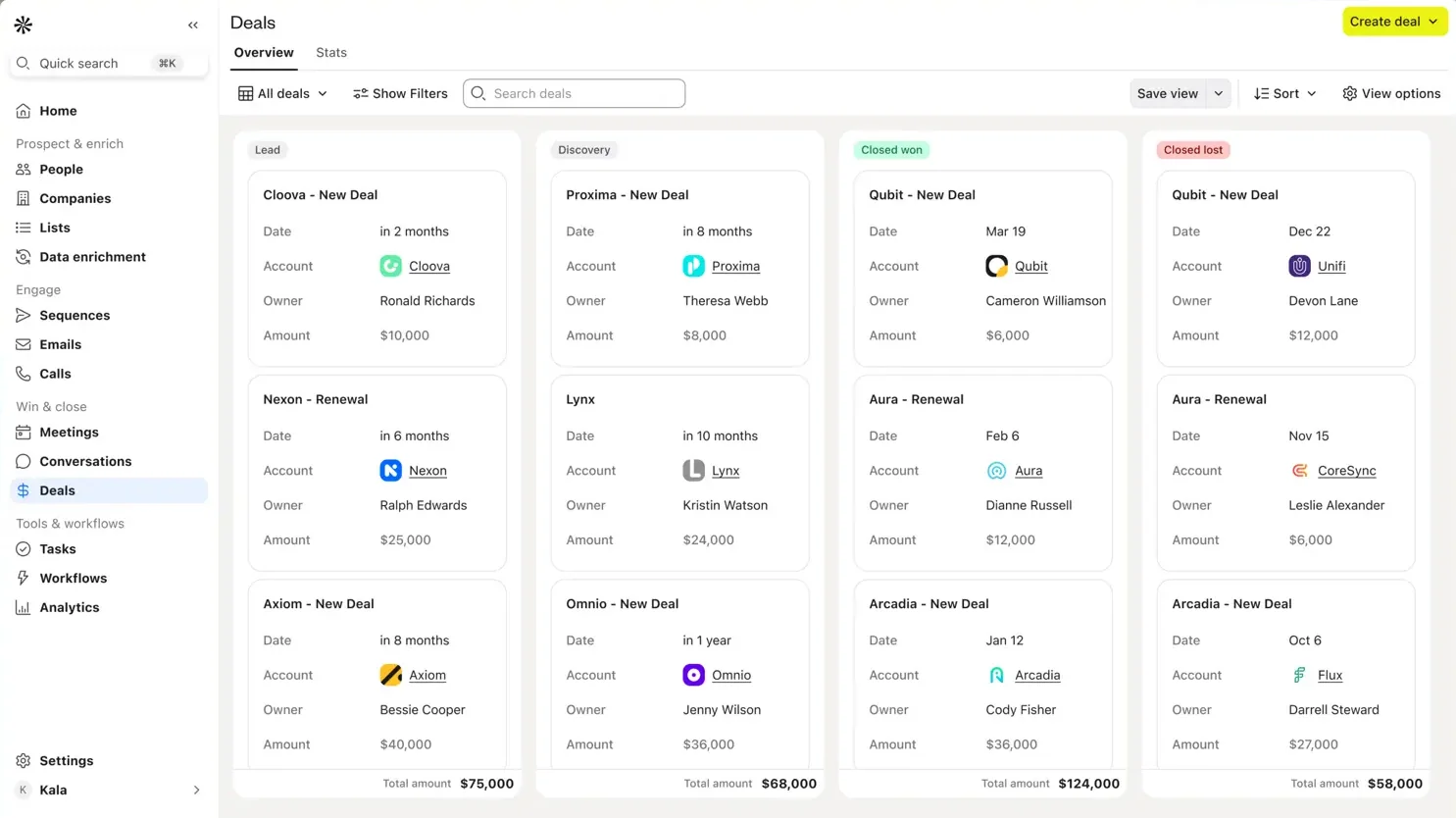
Apollo uses a 240M+ contact database and 30M+ accounts with trusted B2B data to turn fragmented data into a single, complete view of every prospect and account. It’s built for outbound-heavy teams that want prospecting, enrichment, and outreach execution without stitching together separate tools.
Key Features
- AI-powered lead scoring based on fit and engagement signals
- Search and filtering across job title, company size, tech stack, and dozens of other fields
- Built-in email sequencing that runs directly from a qualified list
- AI assistant that surfaces prospect research and recommendations inside the existing workflow
Pricing
Free plan available. Basic is $49/user/month, Professional is $79/user/month, Organization is $119/user/month; billed annually.
Pros
- Ease of use and quick onboarding stand out in user reviews
- Time-saving AI features for research, data cleansing, and personalization
Cons
- Data accuracy can be inconsistent, particularly for international contacts
- Credit limits and usage costs can frustrate smaller teams
G2 rating
4.7/5 (9,800+ reviews)
4. HubSpot (Sales Hub)
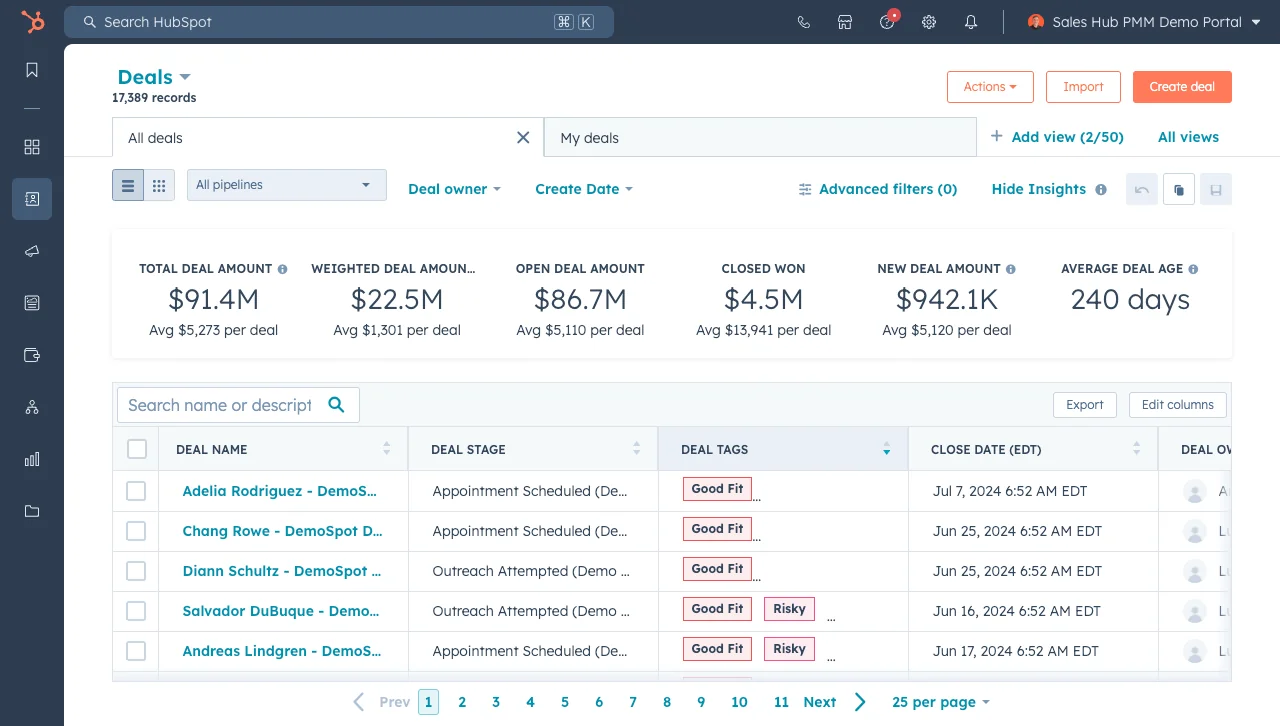
With more than 306,000 customers worldwide, HubSpot is a widely used CRM platform. Its Sales Hub includes AI-powered lead and deal scoring, using machine learning to estimate which contacts are most likely to become customers. It’s a natural fit for B2B teams already using HubSpot that want automated lead qualification built into their existing CRM.
Key Features
- Predictive lead scoring that ranks contacts using historical deal and engagement data
- Breeze Copilot, an AI assistant that surfaces deal, contact, and company insights from CRM data
- Basic lead routing and task automation capabilities
- AI-assisted forecasting that projects pipeline performance from historical rep and deal trends
Pricing
The Starter plan starts at $20/seat/month, Professional at $60/seat/month, and Enterprise at $90/seat/month. Starter and Professional plans have discounts on annual billing.
Pros
- Centralises all sales activity in one place
- Efficient automation features for managing follow-ups and pipeline visibility
Cons
- Advanced features are gated to higher-tier plans; costs can climb as teams scale
- Duplicate records may still require manual review and cleanup
G2 rating
4.4/5 (14,300+ reviews)
5. Warmly
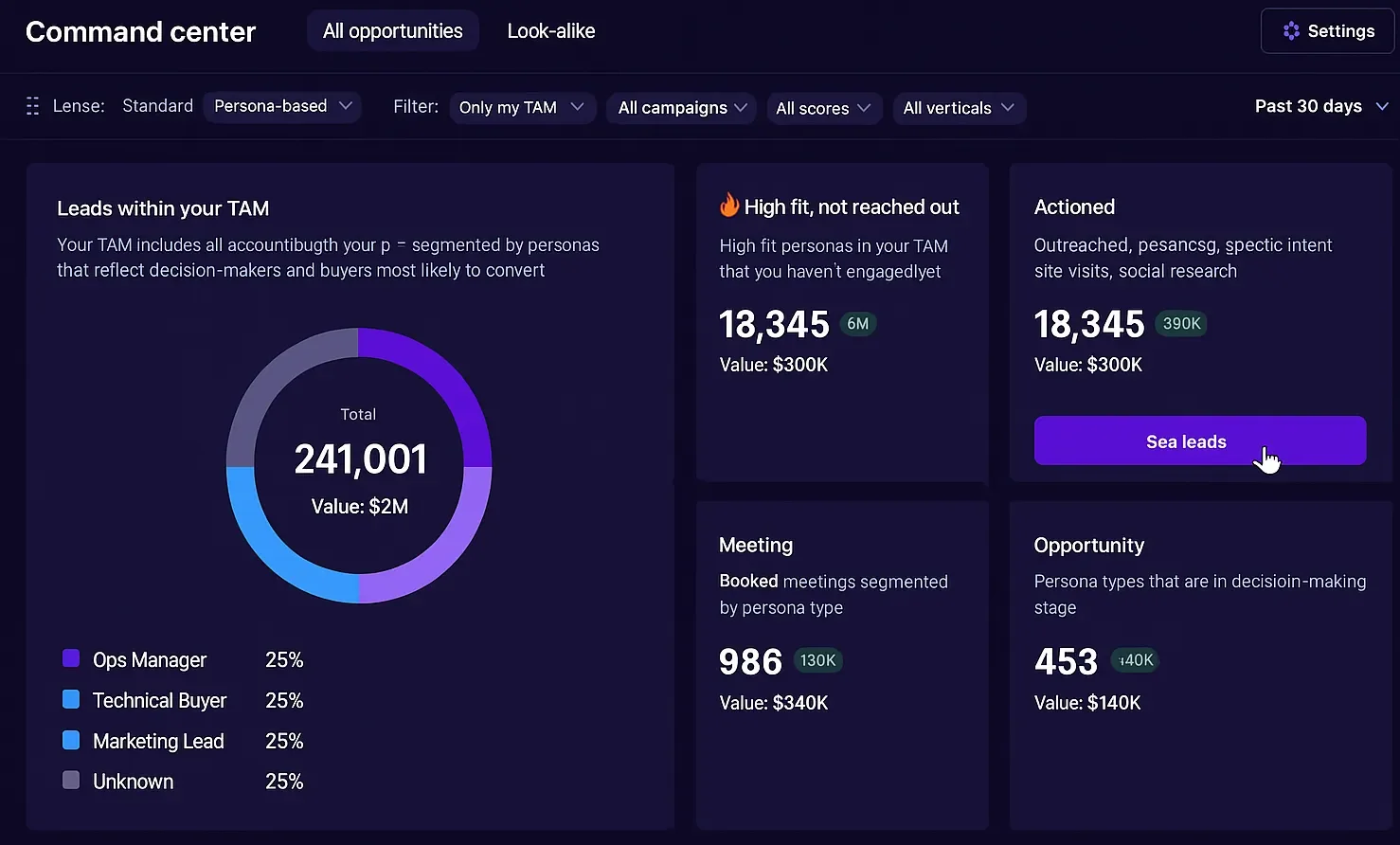
Warmly de-anonymizes website visitors and layers in third-party intent data to prioritize the hottest inbound leads. If you’re getting good traffic but can’t tell who’s worth pursuing, it aims to fill that gap. Warmly announced that it was getting acquired by HubSpot in mid-2026, but its product and operations have stayed the same.
Key Features
- Website visitor identification at the person and company level to help prioritize and convert best-fit prospects.
- AI chatbot that engages visitors in real time and can route conversations to a rep’s calendar
- CRM and outreach tool integrations (primarily HubSpot and Salesforce) that trigger sequences on high-intent visits
- Context graph that logs every site visit, email, and meeting in one place to give agents a full view
Pricing
Plans are tiered, starting at $10k per year for AI Web-Deanonymization, $20k for Inbound Chat, and $30k for AI Inbound Autopilot. Add-on capabilities are available at an extra charge.
Pros
- Accurate visitor identification that sales teams can act on
- Users value its insights for understanding visitor intent
Cons
- CRM integrations are limited mainly to HubSpot and Salesforce
- The $10,000/year entry point may be expensive for smaller teams
G2 rating
4.5/5 (250 reviews)
6. Qualified (Piper)
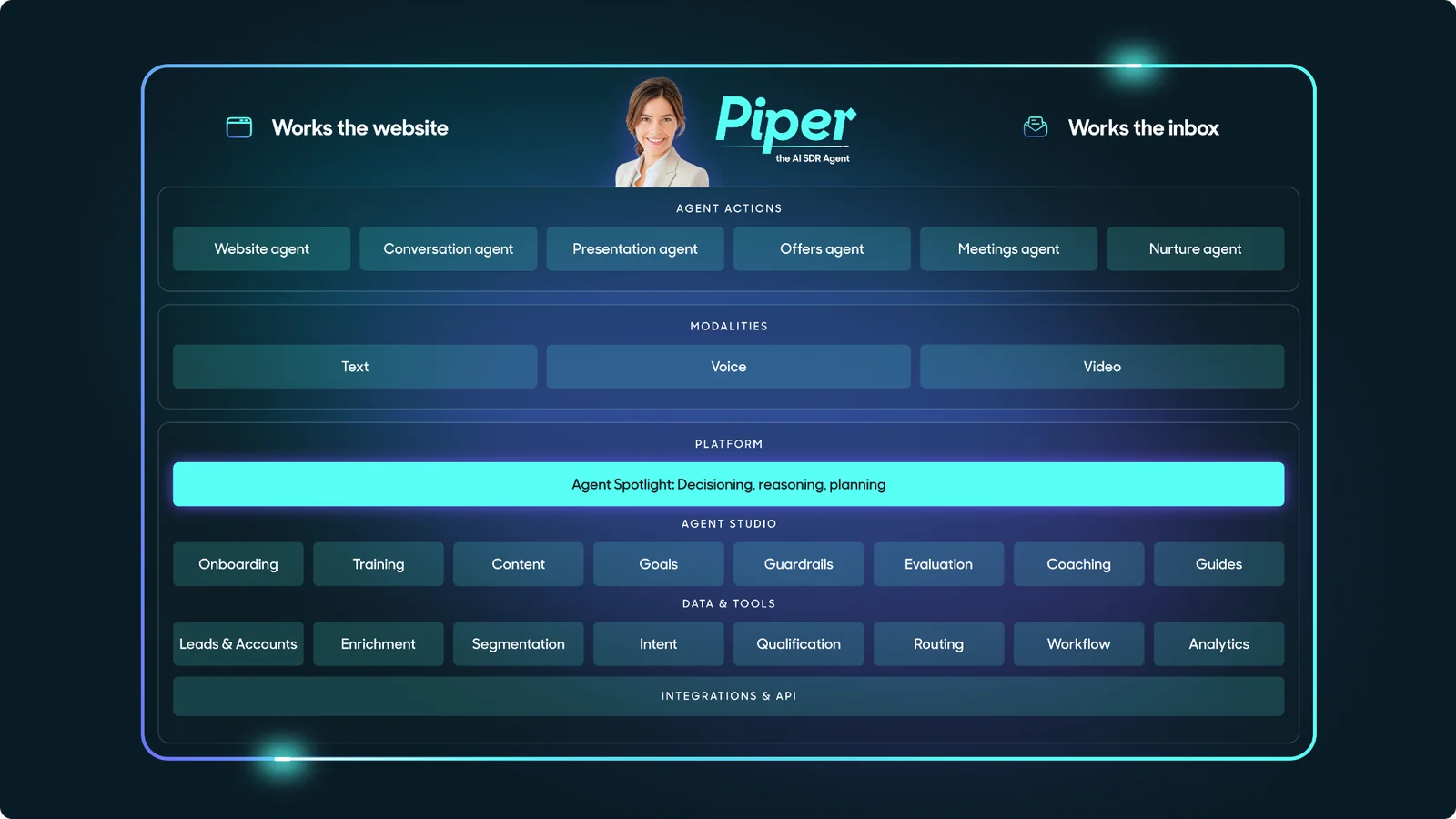
Qualified is a conversational AI platform built specifically for Salesforce users and is now part of the Salesforce ecosystem. Its AI SDR agent, Piper, is designed with capabilities to engage prospects at every touchpoint, instantly and at scale. It oversees the buyer journey from initial interest to a booked meeting.
Key Features
- Real-time website visitor engagement led by Piper AI SDR via chat, voice, and video
- Lead qualification and routing using account history and opportunity data pulled directly from Salesforce
- Bidirectional Salesforce sync in real time without manual CRM updates or CSV imports
- Automated follow-up emails after a conversation, delivering timely messages to nurture and maximize engagement
Pricing
Not published; offers custom quotes on plans tailored to brand pipeline needs.
Pros
- Consistently rated the top inbound AI SDR on G2, with reviewers highlighting real-time qualification and meeting-booking
- Deep Salesforce integration eliminates manual data reconciliation
Cons
- Salesforce CRM is required; doesn’t work natively for other CRM stacks
- Setup and management can be complex; may require guidance
G2 rating
4.9/5 (1,500+ reviews)
7. 6sense
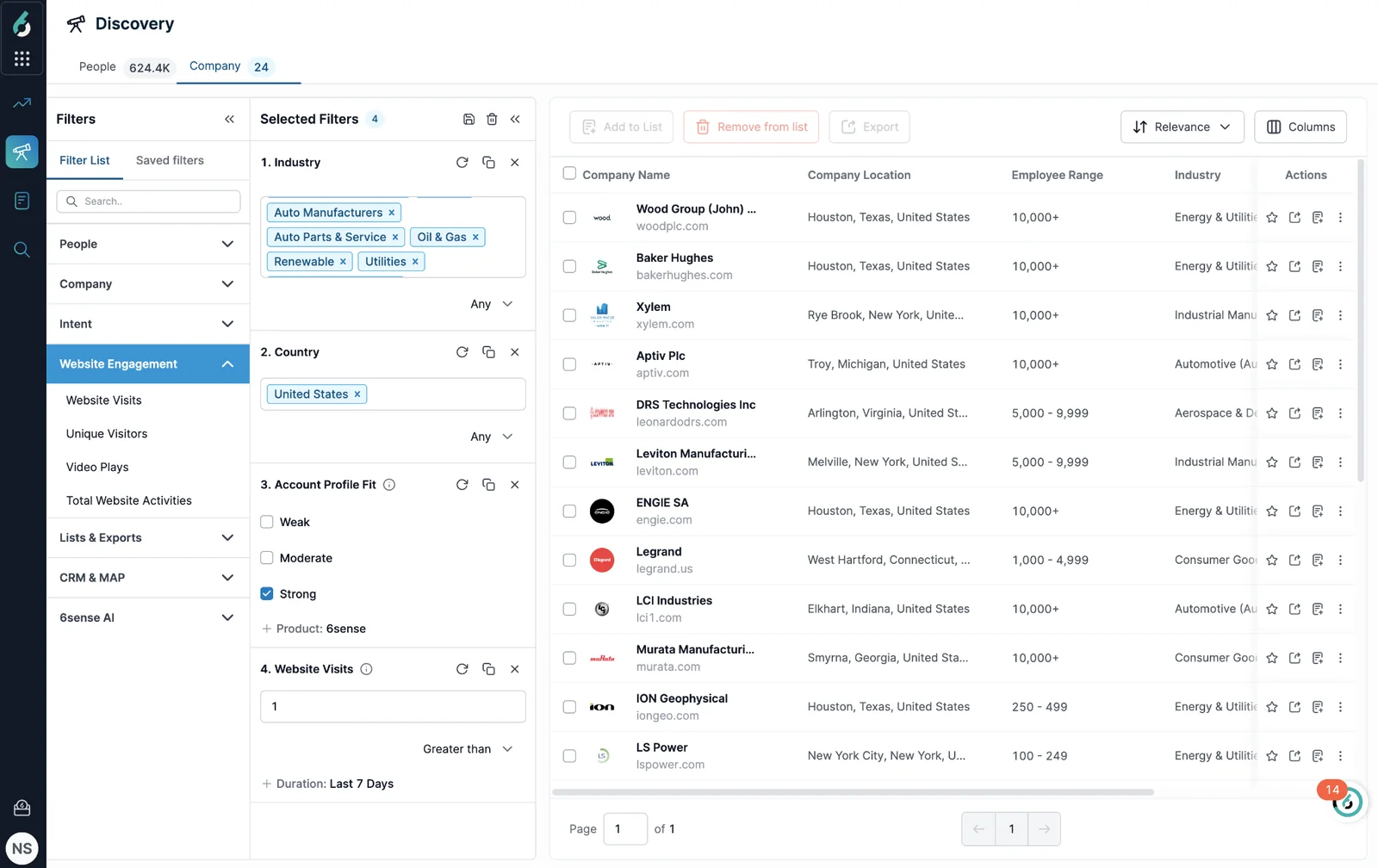
6sense is an account-based, intent-driven prospecting platform that tracks anonymous buying signals across the web to flag accounts actively in-market for your product. If a person is researching your category on third-party sites, 6sense picks that up. It fits mid-market and enterprise teams running dedicated ABM programs.
Key Features
- Proprietary B2B intent data that identifies in-market accounts before they engage directly with your website
- Predictive account scoring based on intent, behavioral, CRM, and profile-fit signals
- Audience targeting and orchestration for paid advertising across multiple channels
- Deep Salesforce integration for syncing account data, segments, and engagement signals
Pricing
No published pricing. Costs vary based on the products, data, and credits included in your contract; commonly cited in the tens-of-thousands-per-year range.
Pros
- Enough intent-data depth and breadth for surfacing dark-funnel activity
- Good for account prioritization when paired with an established ABM motion
Cons
- Complex scoring and predictive models create a learning curve
- Enterprise pricing and implementation requirements can be an entry barrier for smaller teams
G2 rating
4.0/5 (1079 reviews)
8. 11x (Alice)
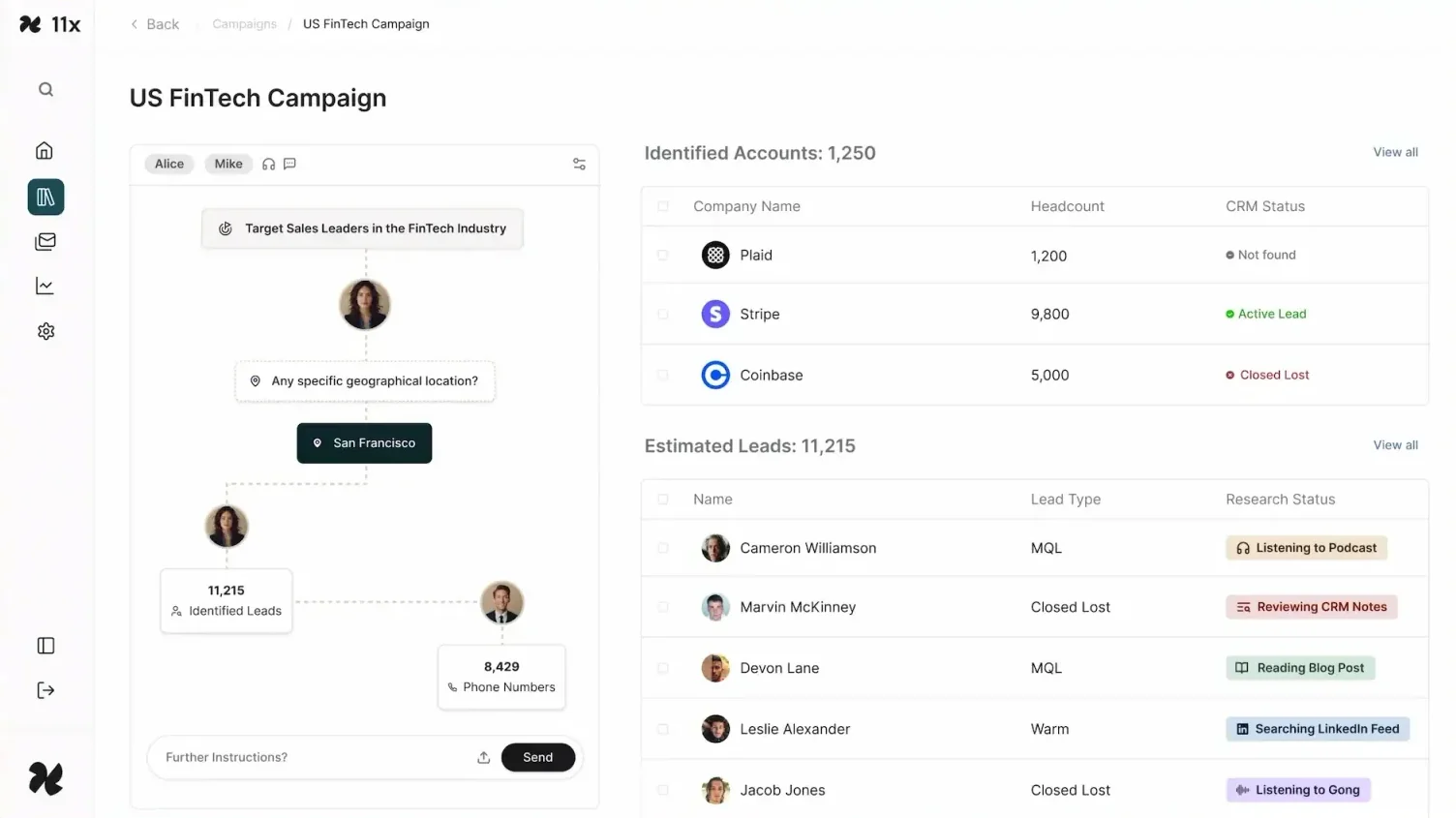
11x offers Alice, an autonomous AI SDR that tackles outbound lead qualification challenges. Alice engages your prospects across channels, handles replies, and drives qualified meetings to build pipeline. 11x targets funded, mid-market to enterprise teams with a well-defined ICP.
Key Features
- Autonomous prospect research and real-time qualification against ICP criteria before outreach
- Multi-channel outreach with AI-personalized message sequences across email, phone, LinkedIn, SMS, and WhatsApp
- 105+ language support for native-language outreach and region-specific research
- Julian AI, a phone agent that answers inbound leads within 60 seconds, qualifies them, and routes them to reps
Pricing
Offers Growth plan starting at $3,750 per month for Alice and $2,417 per month for Julian. Pro and Enterprise plans get custom pricing.
Pros
- Responsive customer support through onboarding
- Relatively wide multichannel breadth (email, LinkedIn, voice)
Cons
- Some users report that AI-generated messages can read as generic
- Setup can be time-consuming and may require fine-tuning
G2 rating
4.4/5 (33 reviews)
9. Instantly
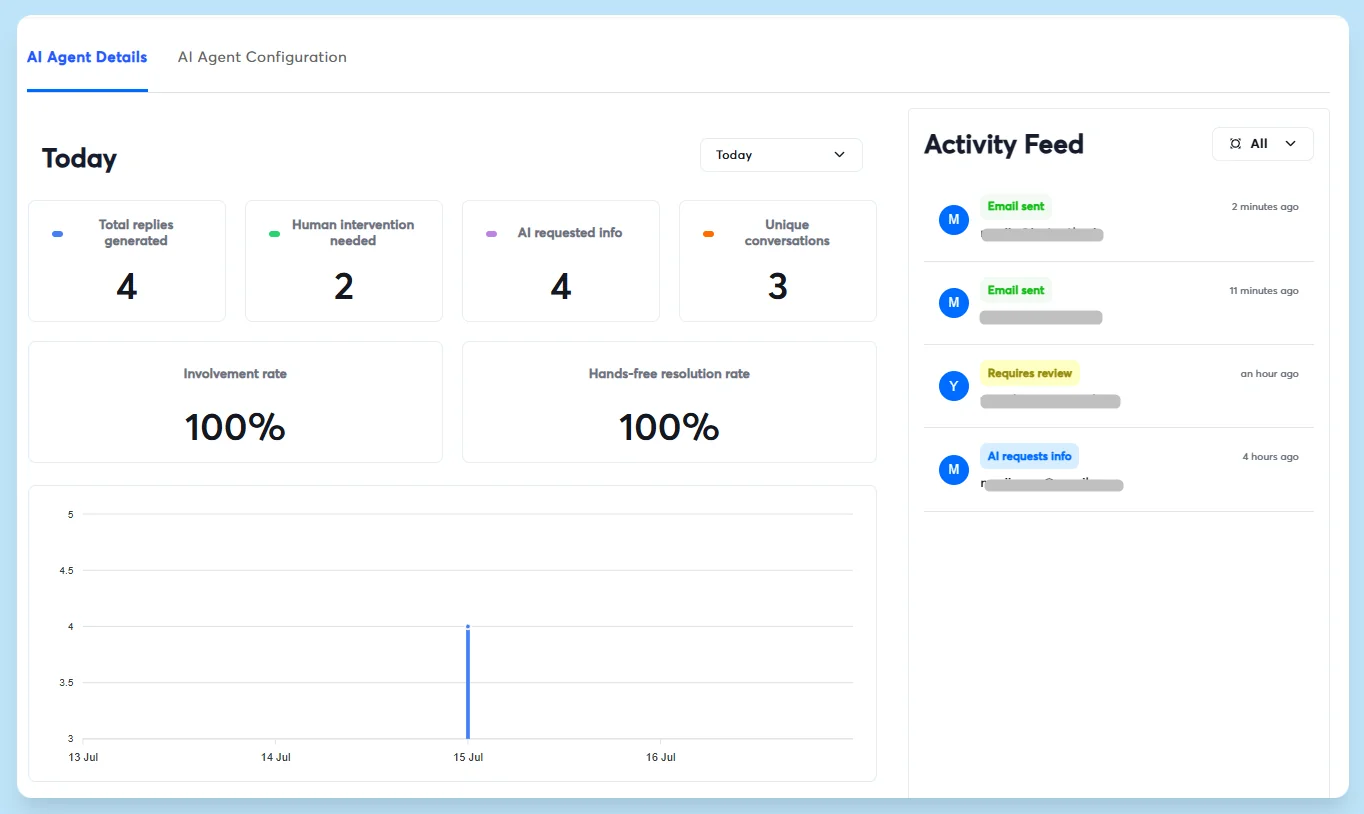
Instantly is a cold outreach platform built around unlimited sending accounts, automated warm-up, and a large B2B contact database. It’s designed for lean teams and agencies running high-volume outbound campaigns who need to qualify leads based on how they respond.
Key Features
- SuperSearch database with advanced filters for industry, company size, revenue, job title, location, tech stack, and other ICP criteria
- Unibox, a unified inbox consolidating replies from connected sending accounts into a single view
- Automated email warm-up and deliverability tools that gradually increase sending activity and help protect domain and inbox health
- Prospect-to-campaign workflow that finds and enriches prospects, then adds them to email campaigns in one platform
Pricing
Pricing starts at $47/month for Outreach and $47/month for Instantly Credits, with custom pricing for VIP plans. Higher-tier plans are available across both offerings, plus discounts for annual billing.
Pros
- AI classification is available across 50+ languages
- Good customer support and quick setup
Cons
- Separate subscriptions with multiple tiers and add-ons make pricing harder to navigate
- LinkedIn outreach requires a third-party integration
G2 rating
4.8/5 (4150+ reviews)
10. RB2B
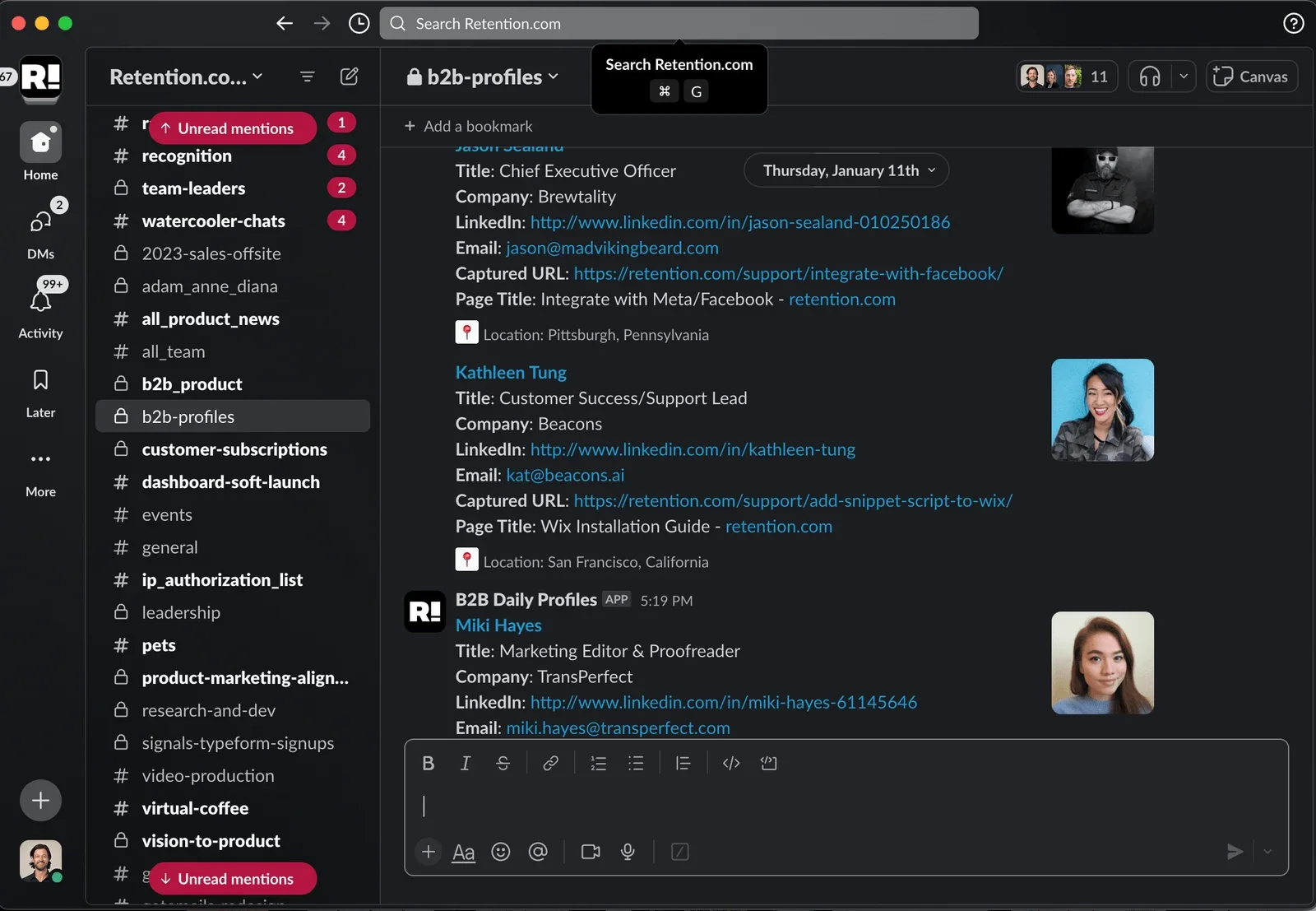
RB2B has built a reputation as one of the simplest, fastest, and least expensive paths to the website visitor signal; it claims users can have it running in under 5 minutes. The platform does one job: it identifies individual visitors on your website at the person level, matching US-based traffic to LinkedIn profiles and contact details.
Key Features
- Contact-level identification, sending website visitor details to CRMs and outbound tools in real time to trigger qualification workflows
- Real-time Slack alerts that notify sales teams when RB2B identifies a visitor, so reps can follow up while interest is high
- Company-level identification for unmatched or international traffic, providing data such as industry, employee count, and revenue
- Repeat-visitor tracking that reveals ongoing interest signals when previously identified visitors return to the site
Pricing
Offers a free plan with 150 credits/month and company-level identification. Paid plans start at $79/month for Starter, $149/month for Pro, and $199/month for Pro+.
Pros
- Free tier and trials with a clear upgrade path
- Users highlight a strong US person-identification accuracy
Cons
- Person-level identification is limited to US visitors
- Limited prospect research and outreach; deeper workflows rely on integrations
G2 rating
4.5/5 (284 reviews)
Build a Lead Qualification Process That Doesn’t Need Babysitting
The right AI tool for qualifying leads depends on where your process stalls. If your challenge is data quality, Clay can clean messy data. If you don’t know who’s visiting your website, Warmly or RB2B provides that information. And if you need account-level intent signals, 6sense is built for that.
We built Swan for the teams who want intent signals, account research, and outreach in one platform. The platform goes beyond just showing you data; it connects the pieces and executes, so your reps spend their time on worthwhile conversations.
Start a free trial and see how Swan works with your existing stack.
FAQs
How does AI qualify leads?
AI lead qualification tools analyze signals like website behavior, company data, engagement history, and buying intent. They compare each lead against your ICP and assign a score or buying stage. More advanced tools research the account, enrich it with contact data, and route qualified leads to the right rep.
Can AI fully replace manual lead qualification?
Not entirely. AI can sort, score, and prioritize leads at scale. But reps still need to make the final call on complex deals, especially in enterprise sales where relationships matter. The goal isn’t to replace your team; it’s to let AI handle volume so they can focus on the conversations most likely to close.
What’s the difference between lead scoring and lead qualification?
Lead scoring assigns a number based on criteria like company size, job title, or email engagement. Lead qualification is a broader process: determining whether a lead is ready for sales, covering scoring, research, data enrichment, and intent analysis. A lead can score high and still not be qualified if the timing or budget isn’t right.
How much do the best AI tools for lead qualification cost?
Pricing varies widely. Apollo and Instantly start at around $50/month, while Clay starts at $167/month and goes up to $446/month for its Growth plan. Platforms targeting growth-stage or enterprise teams, such as Swan, 6sense, and Qualified, use custom pricing.
What signals should AI track for lead qualification?
The most useful buying signals include website visits to pricing or product pages, content downloads, and email engagement. LinkedIn activity, third-party intent data, funding rounds, and hiring patterns also matter. The best tools combine multiple signal types so you don’t rely on a single data point.