
Company· 3 min read
We Call Them AI Tourists. They're Running Our Marketing.
Your cheapest marketing channel is users who find your product impressive enough to share. Here's why we spend $20K a month letting them in.
 Amos Bar-JosephCo-Founder & CEO ·
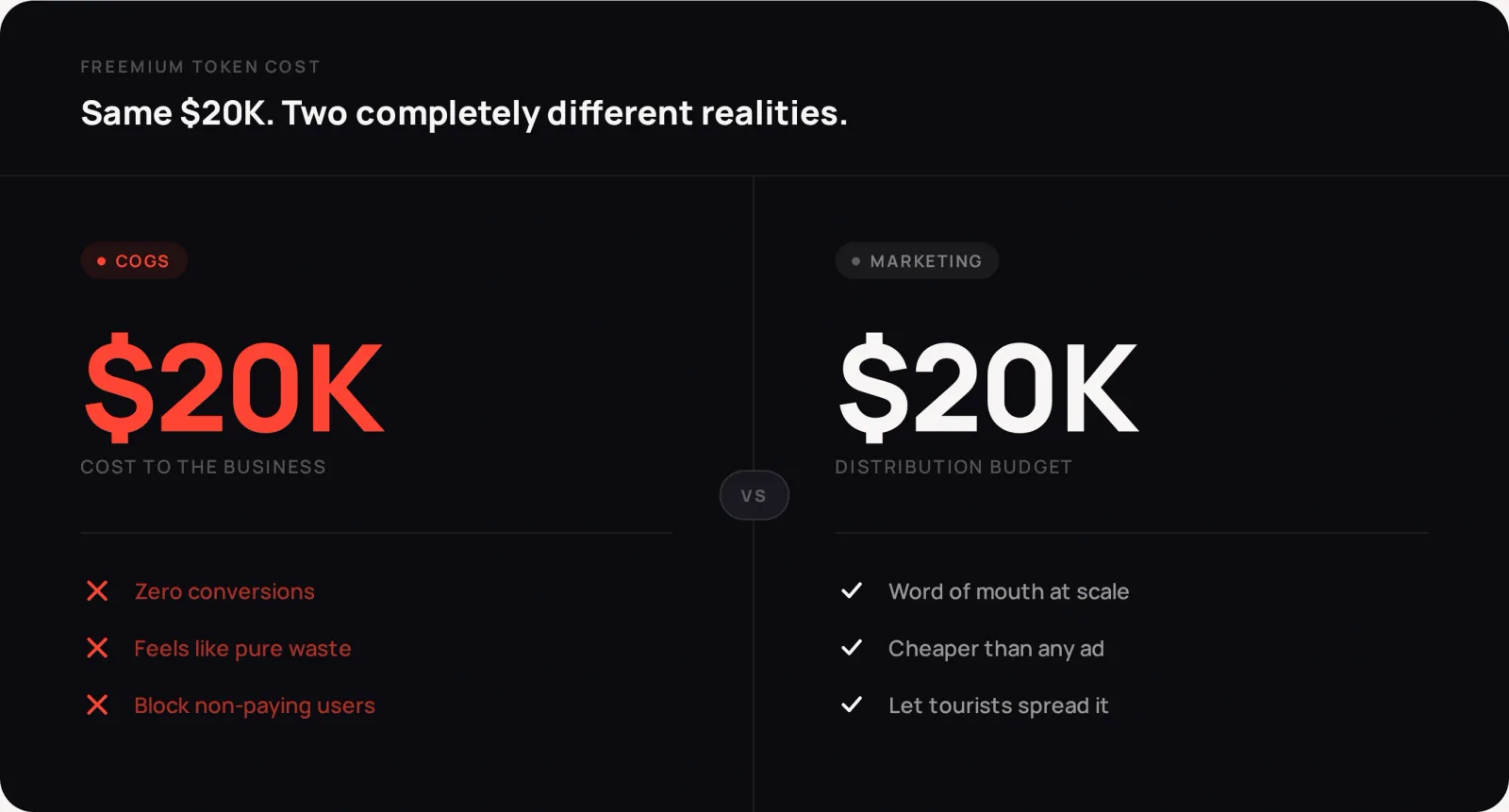
- Freemium token cost belongs on the marketing P&L, not COGS. It is distribution spend, not product overhead.
- Non-converting users spread impressive products because sharing something they discovered creates social currency for the sharer.
- This only works under one condition: the product has to genuinely impress. Average products get tried and forgotten.
- Every token a tourist consumes costs less than any paid ad impression you will ever run.
- The quality gate is not optional. If your product is average, tourists are a pure cost.
$20K in tokens. Zero conversions. Best-performing item on our P&L.
That combination should not make sense. Most people who see a line like that on a financial review call an emergency meeting. They talk about CAC, payback period, and conversion thresholds. They talk about turning the spend off.
We looked at the same number and decided to let it grow.
The users burning those tokens were never going to buy. We knew that. They signed up out of curiosity, not necessity. We started calling this group AI tourists. And the reason we let them in anyway is that the people least likely to pay are the most likely to talk.
Why We Moved Token Spend Off COGS
Elena Verna, Head of Growth at Lovable, said it plainly: “Why would we prevent a person who wants to do all the marketing for us from using us?”
Her logic is clean. Freemium token cost is not a product cost. It is a marketing cost. Move it to that line and the entire calculus changes.
When token spend sits on COGS, the pressure is to reduce it. Cut access. Gate the experience. Every non-paying user becomes a liability.
When it sits on marketing, the question shifts. Are these users generating awareness? Are they spreading the product? If yes, the spend is doing its job.
We made that shift in how we think about this at Swan. We stopped treating non-paying users as a cost problem and started asking what they were doing after they left.
Why Non-Converting Users Spread Products
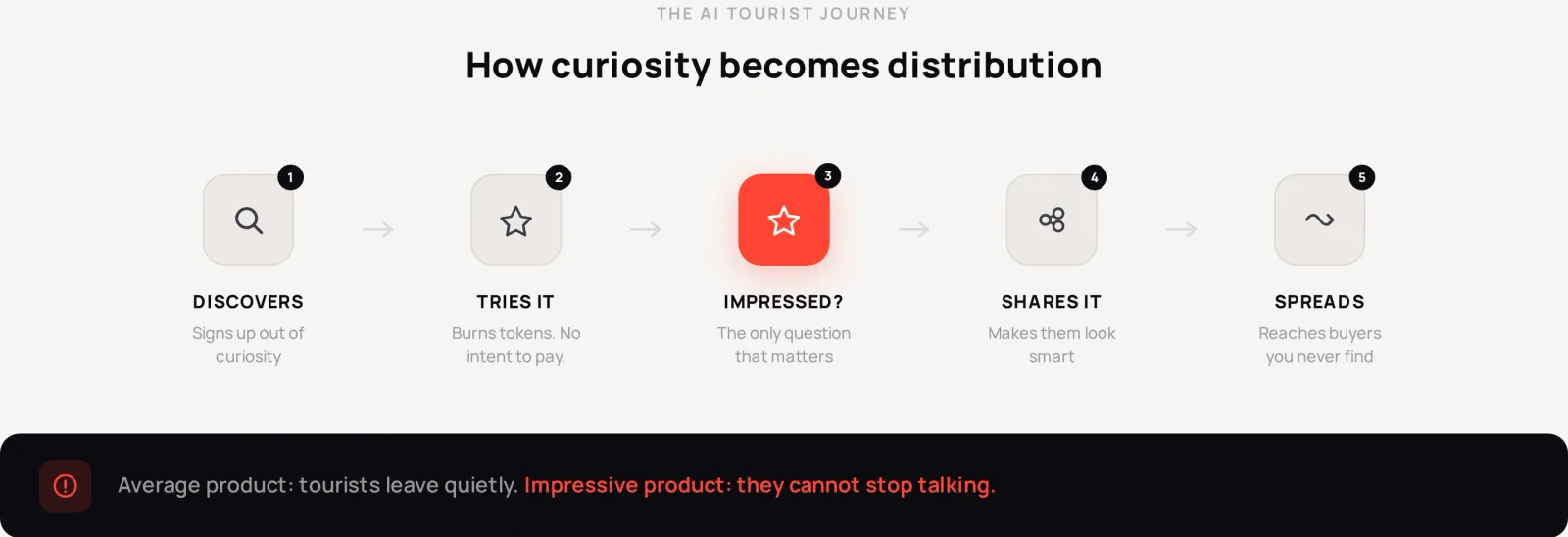
Tourists do not share because they want to help you grow. They share because sharing makes them look good.
When someone builds a real workflow with an AI agent, something that used to take them hours now running in minutes, they do not keep that quiet. They post it. They show their team. They send the link to three people.
Not because of your product. Because of how it makes them look. Ahead of the curve. Technical. Smart.
This is the social currency principle. People share things that reflect well on themselves. Discovery is shareable. Impressive is shareable. Average is forgettable.
Every tourist who shares is running a word-of-mouth campaign at zero marginal cost to you. And unlike a paid ad, the message comes from someone their network trusts.
The Condition That Makes This Work
This strategy has exactly one requirement.
The product has to impress.
Not adequate. Not functional. Impressive. The kind of result that makes someone stop and think: I need to show this to someone.
If your product does not hit that bar, tourists try it and move on. No post. No referral. No word of mouth. Just wasted spend.
The mechanism only fires when the product delivers something unexpected. A workflow that actually runs end to end. An outcome that surprises them. A result they did not think was possible.
We know this from experience. The tourists who generate downstream signups at Swan are the ones who ran something real and got a result they did not expect. Not the ones who clicked around.
If your product cannot create that moment, the strategy does not work. Fix the product first.
The spend is real. The conversions are zero. The pipeline it generates is not.
Worth paying attention to.
Amos is building the first autonomous business, on a mission to reach $30M ARR with just 3 founders and AI agents. Previously built, scaled, and exited two B2B startups. Now documenting the journey of replacing the growth-at-all-costs playbook with intelligence-driven GTM. Based in Tel Aviv. Philosophy, Politics, Economics & Law from Tel Aviv University.