
Company· 4 min read
We Spent $217K on AI in 4 Months. Here's What That Taught Us About Pricing
We spent $217K on AI in 4 months as a 4-person team. Here's why taking a margin on token consumption is the wrong business model for AI companies.
 Amos Bar-JosephCo-Founder & CEO ·
- A 4-person team spending $217K on AI compute in 4 months is not unusual for AI platforms running at scale.
- Marking up AI tokens creates a race to the bottom — your margin compresses every time a competitor undercuts you on infrastructure you did not build.
- The sustainable model treats AI compute as a utility cost passed through at cost, like electricity.
- What you charge for is the platform, the orchestration layer, and the system that makes AI useful — none of that is a commodity.
- Letting customers bring their own models does not threaten this model. It proves the point.
We spent $217,000 on AI compute in four months.
Four people. One product. Real workflows running for real companies. Every execution burned real tokens.
That number is not a typo. It is also not a crisis.
What it is: the clearest possible argument for how AI companies need to think about pricing.
I keep coming back to this every time someone asks how we handle AI costs. The answer is not a clever pricing trick. It is a structural decision about what your company actually is.
The Bill That Did Not Surprise Us
Over 800 companies ran workflows through Swan last month. Each one triggered real compute. Each one cost us real money.
Unlike traditional software, AI compute does not flatten as you scale. There is no point at which the infrastructure pays for itself and the margins widen. The bill grows with your customers, because every execution is a new event.
We knew this going in. The $217K was not a wake-up call. It was evidence that the system was working.
But it forced a question: how do you build a business where your core input cost scales with revenue?
The Middleman Trap Most AI Companies Fall Into
The obvious answer is to mark up the tokens.
Buy compute wholesale. Bundle it into your pricing. Sell it retail. Take the margin on every token your customer consumes.
It feels like a real business model. You are reselling intelligence, just like any distributor resells inventory. You know your wholesale cost. You set your margin. You print.
Here is the problem.
You did not build the intelligence. You are just the pipe it flows through.
And once you become a pipe, you can be replaced by a cheaper pipe.
A competitor shows up. Same intelligence underneath, thinner margin on top. Then another. Then another. Your pricing is now in a race to the bottom over something you had nothing to do with building.
You are not competing on your product anymore. You are competing on how little margin you are willing to eat on someone else’s technology.
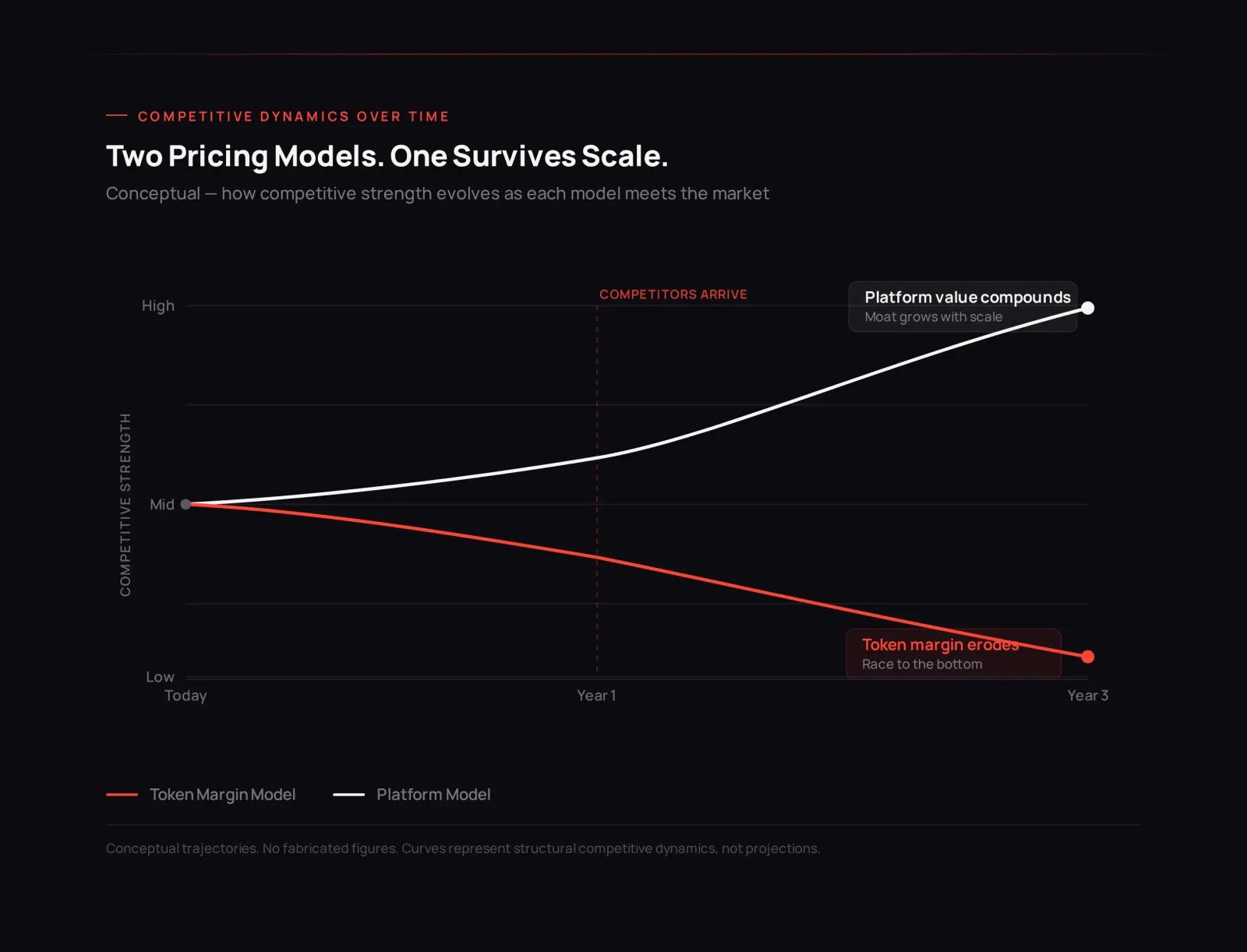
Token margin model erodes as competitors undercut pricing while platform model compounds in competitive strength over scale
What Happens to Middlemen
This is not a new story.
Every industry that built a business on marking up someone else’s commodity eventually ran into the same wall. The margin compresses. The differentiation disappears. The only way to survive is to become the cheapest version of something that was never yours to begin with.
That is not a business. That is a slow erosion.
The AI layer is not special here. The economics are identical. The only question is how long it takes for the market to figure it out.
I think we are about 18 months from a repricing event across most AI tools. The companies that built their revenue model on token margins are going to feel it first.
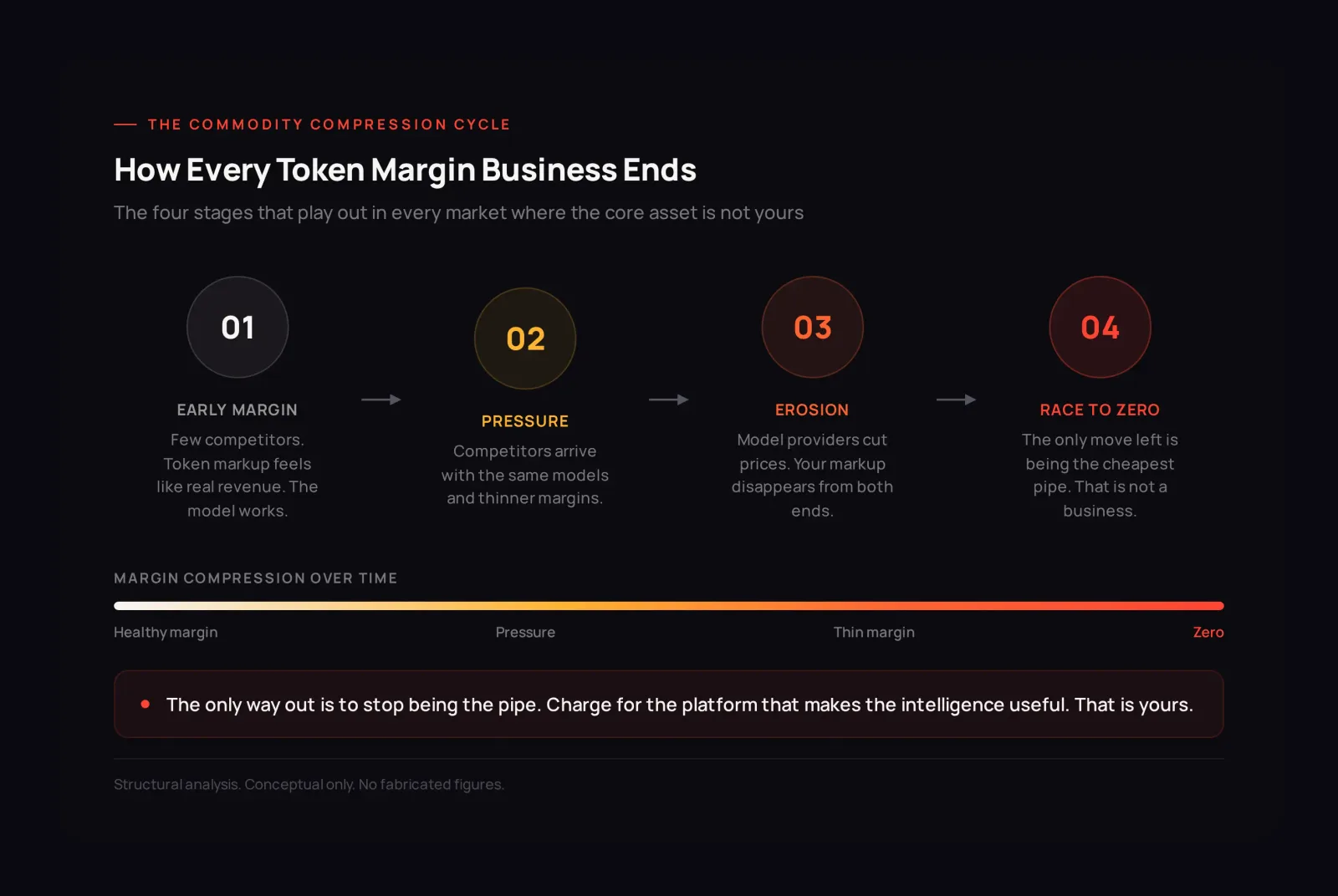
Four-stage token margin commodity compression cycle: early margin, pressure, erosion, race to zero
Treat AI Compute Like Electricity
The sustainable path is to stop treating AI costs as your revenue center.
Pass them through at cost. Transparently. Like electricity.
Your customers are not paying you for tokens. They are paying you for what the tokens produce. The research. The workflows. The execution layer that turns a GTM motion into something that actually runs.
The compute is infrastructure. Infrastructure should be priced like infrastructure.
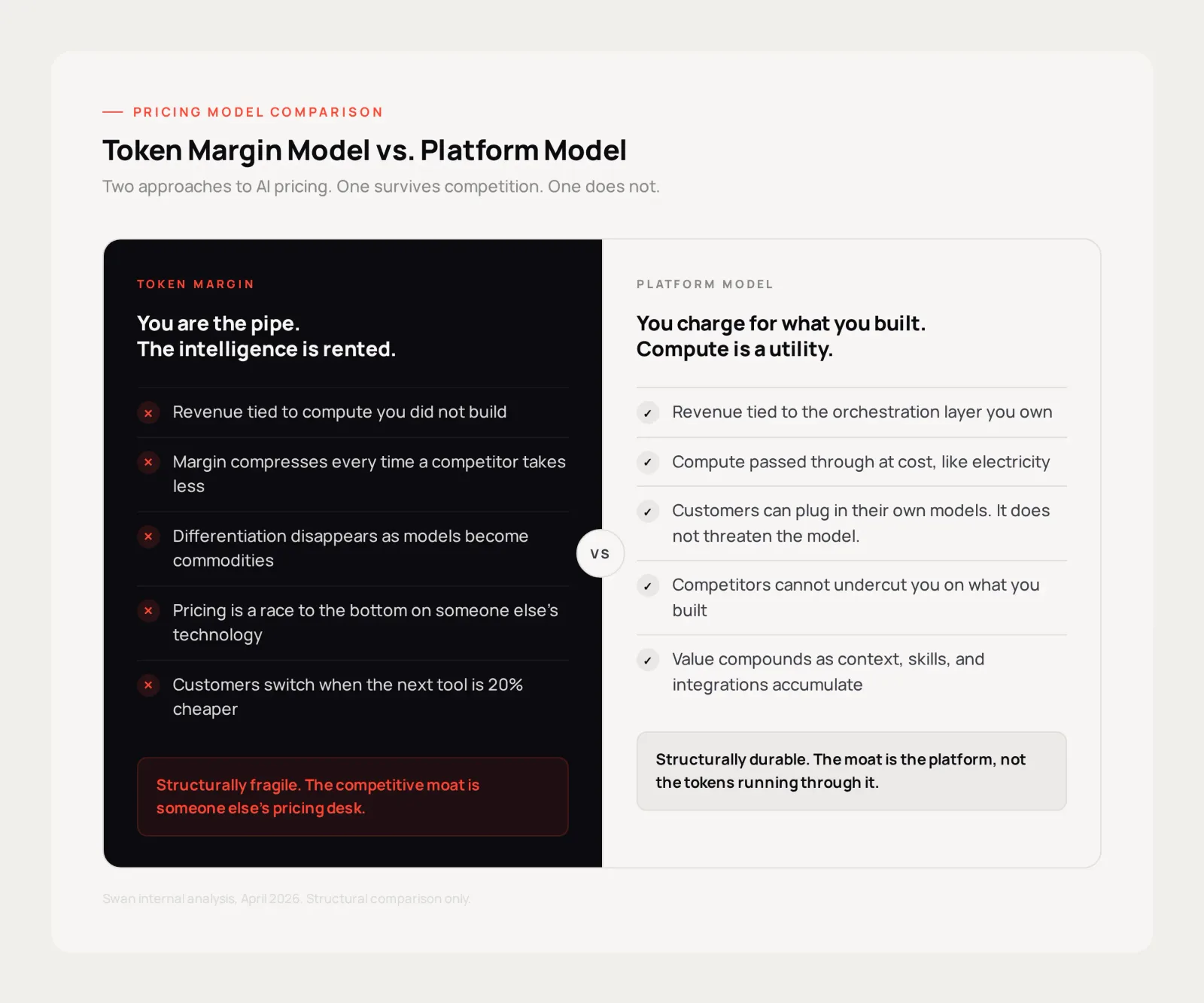
Token margin model vs platform model compared across structure competitive dynamics and long-term durability
What You Actually Charge For
The platform is yours. The orchestration layer is yours. The system of skills, triggers, context memory, and integrations that makes the AI useful — that is yours.
No competitor can undercut you on it by eating a thinner margin. It is not a commodity. You built it. It reflects decisions you made, problems you solved, and context you accumulated. None of that is available at wholesale.
You can even let customers plug in their own models if they have better AI pricing. It does not threaten the model. If anything, it proves the point. They are not paying for the intelligence. They are paying for the harness around it.
This is SaaS economics applied cleanly to the AI layer. Charge for the software you built. Let the compute be a utility.
We have done this before. We just forgot it when AI made everything feel new.
The business worth building is the one that is valuable regardless of which model is running underneath it. That is the only version of this that does not eventually collapse under its own margin pressure.
Worth paying attention to.
Amos is building the first autonomous business, on a mission to reach $30M ARR with just 3 founders and AI agents. Previously built, scaled, and exited two B2B startups. Now documenting the journey of replacing the growth-at-all-costs playbook with intelligence-driven GTM. Based in Tel Aviv. Philosophy, Politics, Economics & Law from Tel Aviv University.